
Publications
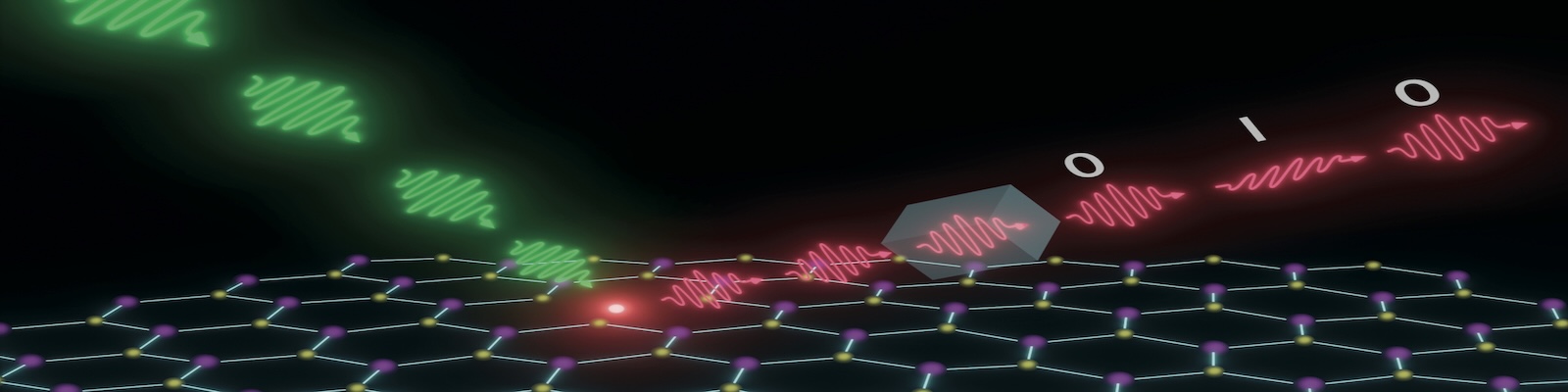
| 28. | Sinan Genc; Oguzhan Yucel; Furkan Aglarci; Carlos Rodriguez-Fernandez; Alpay Yilmaz; Humeyra Caglayan; Serkan Ates; Alpan Bek Disorder-Engineered Hybrid Plasmonic Cavities for Emission Control of Defects in hBN Journal Article arXiv:2506.14517, 2025. @article{Genc.Bek.2025, title = {Disorder-Engineered Hybrid Plasmonic Cavities for Emission Control of Defects in hBN}, author = {Sinan Genc and Oguzhan Yucel and Furkan Aglarci and Carlos Rodriguez-Fernandez and Alpay Yilmaz and Humeyra Caglayan and Serkan Ates and Alpan Bek}, doi = {10.48550/arXiv.2506.14517}, year = {2025}, date = {2025-06-17}, journal = {arXiv:2506.14517}, abstract = {Defect-based quantum emitters in hexagonal boron nitride (hBN) are promising building blocks for scalable quantum photonics due to their stable single-photon emission at room temperature. However, enhancing their emission intensity and controlling the decay dynamics remain significant challenges. This study demonstrates a low-cost, scalable fabrication approach to integrate plasmonic nanocavities with defect-based quantum emitters in hBN nanoflakes. Using the thermal dewetting process, we realize two distinct configurations: stochastic Ag nanoparticles (AgNPs) on hBN flakes and hybrid plasmonic nanocavities formed by AgNPs on top of hBN flakes supported on gold/silicon dioxide (Au/SiO2) substrates. While AgNPs on bare hBN yield up to a two-fold photoluminescence (PL) enhancement with reduced emitter lifetimes, the hybrid nanocavity architecture provides a dramatic, up to 100-fold PL enhancement and improved uniformity across multiple. emitters, all without requiring deterministic positioning. Finite-difference time-domain (FDTD) simulations and time-resolved PL measurements confirm size-dependent control over decay dynamics and cavity-emitter interactions. Our versatile solution overcomes key quantum photonic device development challenges, including material integration, emission intensity optimization, and spectral multiplexity. Future work will explore potential applications in integrated photonic circuits hosting on-chip quantum systems and hBN-based label-free single-molecule detection through such quantum nanoantennas.}, keywords = {}, pubstate = {published}, tppubtype = {article} } Defect-based quantum emitters in hexagonal boron nitride (hBN) are promising building blocks for scalable quantum photonics due to their stable single-photon emission at room temperature. However, enhancing their emission intensity and controlling the decay dynamics remain significant challenges. This study demonstrates a low-cost, scalable fabrication approach to integrate plasmonic nanocavities with defect-based quantum emitters in hBN nanoflakes. Using the thermal dewetting process, we realize two distinct configurations: stochastic Ag nanoparticles (AgNPs) on hBN flakes and hybrid plasmonic nanocavities formed by AgNPs on top of hBN flakes supported on gold/silicon dioxide (Au/SiO2) substrates. While AgNPs on bare hBN yield up to a two-fold photoluminescence (PL) enhancement with reduced emitter lifetimes, the hybrid nanocavity architecture provides a dramatic, up to 100-fold PL enhancement and improved uniformity across multiple. emitters, all without requiring deterministic positioning. Finite-difference time-domain (FDTD) simulations and time-resolved PL measurements confirm size-dependent control over decay dynamics and cavity-emitter interactions. Our versatile solution overcomes key quantum photonic device development challenges, including material integration, emission intensity optimization, and spectral multiplexity. Future work will explore potential applications in integrated photonic circuits hosting on-chip quantum systems and hBN-based label-free single-molecule detection through such quantum nanoantennas. | 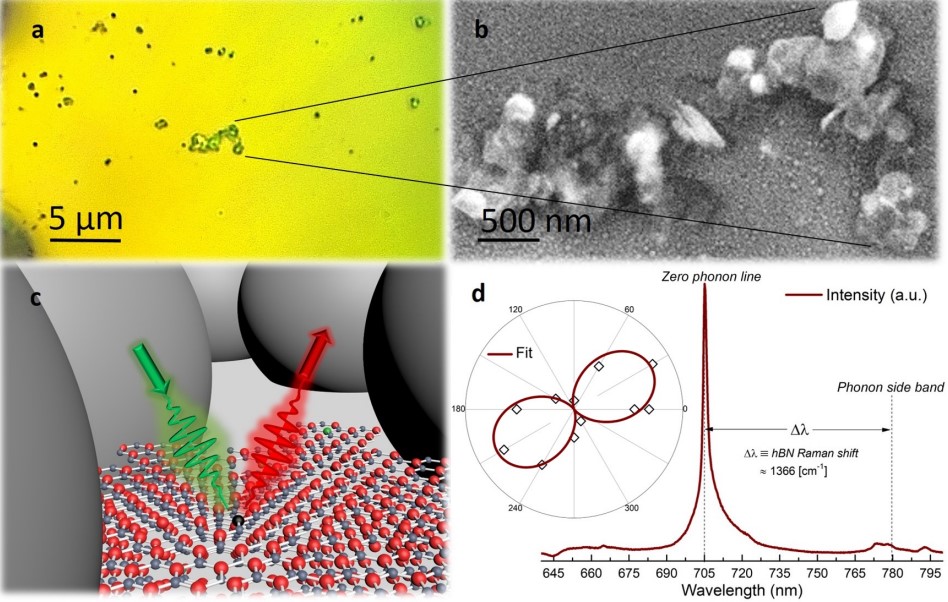 |
| 27. | J.-V. Vidal Martínez-Pons, S.-K. Kim, M. Behrens, A. Izquierdo-Molina, A. Menendez Rua, S. Paçal, S. Ateş, L. Viña, C. Antón-Solanas Temporal coherence of single photons emitted by hexagonal Boron Nitride defects at room temperature Journal Article arXiv:2505.10644, 2025. @article{Vidal_2025, title = {Temporal coherence of single photons emitted by hexagonal Boron Nitride defects at room temperature}, author = {J.-V. Vidal Martínez-Pons, S.-K. Kim, M. Behrens, A. Izquierdo-Molina, A. Menendez Rua, S. Paçal, S. Ateş, L. Viña, C. Antón-Solanas}, url = {https://arxiv.org/abs/2505.10644}, doi = {https://doi.org/10.48550/arXiv.2505.10644}, year = {2025}, date = {2025-05-15}, journal = {arXiv:2505.10644}, abstract = {Color centers in hexagonal boron nitride (hBN) emerge as promising quantum light sources at room temperature, with potential applications in quantum communications, among others. The temporal coherence of emitted photons (i.e. their capacity to interfere and distribute photonic entanglement) is essential for many of these applications. Hence, it is crucial to study and determine the temporal coherence of this emission under different experimental conditions. In this work, we report the coherence time of the single photons emitted by an hBN defect in a nanocrystal at room temperature, measured via Michelson interferometry. The visibility of this interference vanishes when the temporal delay between the interferometer arms is a few hundred femtoseconds, highlighting that the phonon dephasing processes are four orders of magnitude faster than the spontaneous decay time of the emitter. We also analyze the single photon characteristics of the emission via correlation measurements, defect blinking dynamics, and its Debye-Waller factor. Our room temperature results highlight the presence of a strong phonon-electron coupling, suggesting the need to work at cryogenic temperatures to enable quantum photonic applications based on photon interference.}, keywords = {}, pubstate = {published}, tppubtype = {article} } Color centers in hexagonal boron nitride (hBN) emerge as promising quantum light sources at room temperature, with potential applications in quantum communications, among others. The temporal coherence of emitted photons (i.e. their capacity to interfere and distribute photonic entanglement) is essential for many of these applications. Hence, it is crucial to study and determine the temporal coherence of this emission under different experimental conditions. In this work, we report the coherence time of the single photons emitted by an hBN defect in a nanocrystal at room temperature, measured via Michelson interferometry. The visibility of this interference vanishes when the temporal delay between the interferometer arms is a few hundred femtoseconds, highlighting that the phonon dephasing processes are four orders of magnitude faster than the spontaneous decay time of the emitter. We also analyze the single photon characteristics of the emission via correlation measurements, defect blinking dynamics, and its Debye-Waller factor. Our room temperature results highlight the presence of a strong phonon-electron coupling, suggesting the need to work at cryogenic temperatures to enable quantum photonic applications based on photon interference. | 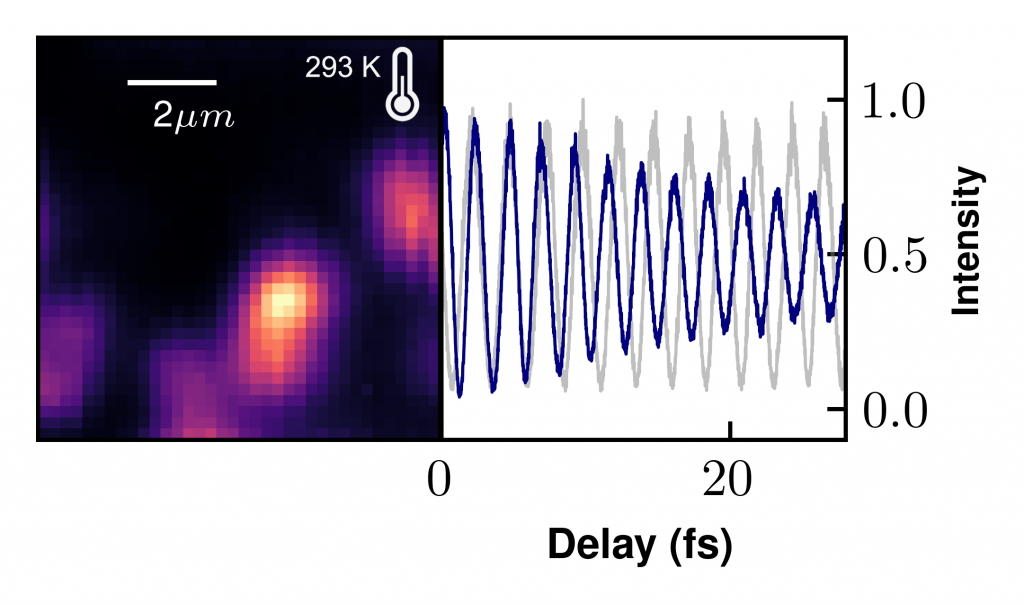 |
| 26. | Ömer S. Tapşın, Furkan Ağlarcı, Roberto G. Pousa, Daniel K. L. Oi, Mustafa Gündoğan, Serkan Ateş Secure Quantum Key Distribution with Room-Temperature Quantum Emitter Journal Article arXiv:2501.13902, 2025. @article{Tapsin2025, title = {Secure Quantum Key Distribution with Room-Temperature Quantum Emitter}, author = {Ömer S. Tapşın, Furkan Ağlarcı, Roberto G. Pousa, Daniel K. L. Oi, Mustafa Gündoğan, Serkan Ateş}, url = {https://arxiv.org/abs/2501.13902}, doi = {10.48550/arXiv.2501.13902}, year = {2025}, date = {2025-04-24}, journal = {arXiv:2501.13902}, abstract = {On-demand generation of single photons from solid-state quantum emitters is essential to build practical quantum networks and QKD systems by potentially enabling higher secure key rates (SKR) and lower quantum bit error rates (QBER) in short-range distances. Room-temperature operation is particularly important as it eliminates the need for bulky cryogenic setups, reducing complexity and cost for real-world applications. In this work, we showcase the versatility of defects in hexagonal boron nitride (hBN) at room temperature by implementing the B92 protocol. Our experiments yield a sifted key rate (SiKR) of 17.5 kbps with a QBER of 6.49% at a dynamic polarization encoding rate of 40 MHz, and finite-key analysis provides a SKR of 7 kbps, one of the highest achieved for a room-temperature single photon source. We analyzed the non-decoy efficient BB84 using our hBN emitter and other promising quantum dot source for QKD, and compare their key performance with a single quantum repeater scenario. We also explore potential applications of hBN defects beyond QKD and analyze scenarios that could outperform conventional point-to-point QKD schemes. These results underscore the promise of hBN emitters for advancing quantum communication technologies.}, keywords = {}, pubstate = {published}, tppubtype = {article} } On-demand generation of single photons from solid-state quantum emitters is essential to build practical quantum networks and QKD systems by potentially enabling higher secure key rates (SKR) and lower quantum bit error rates (QBER) in short-range distances. Room-temperature operation is particularly important as it eliminates the need for bulky cryogenic setups, reducing complexity and cost for real-world applications. In this work, we showcase the versatility of defects in hexagonal boron nitride (hBN) at room temperature by implementing the B92 protocol. Our experiments yield a sifted key rate (SiKR) of 17.5 kbps with a QBER of 6.49% at a dynamic polarization encoding rate of 40 MHz, and finite-key analysis provides a SKR of 7 kbps, one of the highest achieved for a room-temperature single photon source. We analyzed the non-decoy efficient BB84 using our hBN emitter and other promising quantum dot source for QKD, and compare their key performance with a single quantum repeater scenario. We also explore potential applications of hBN defects beyond QKD and analyze scenarios that could outperform conventional point-to-point QKD schemes. These results underscore the promise of hBN emitters for advancing quantum communication technologies. | 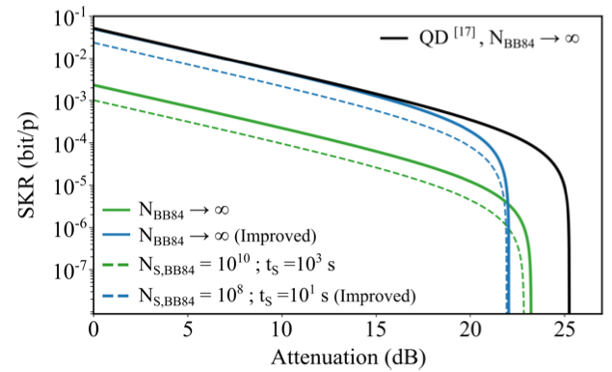 |
| 25. | Çağlar Samaner, Serkan Ateş Time-Resolved Stokes Analysis of Single Photon Emitters in Hexagonal Boron Nitride Journal Article arXiv:2504.11193, 2025. @article{Samaner_2025, title = {Time-Resolved Stokes Analysis of Single Photon Emitters in Hexagonal Boron Nitride}, author = {Çağlar Samaner, Serkan Ateş}, url = {https://arxiv.org/abs/2504.11193}, doi = {10.48550/arXiv.2504.11193}, year = {2025}, date = {2025-04-15}, journal = {arXiv:2504.11193}, abstract = {Solid-state quantum emitters play a vital role in advancing quantum technologies, particularly in quantum computation and communication, where single-photon polarization acts as a fundamental information carrier. Precise polarization characterization is essential for understanding the mechanisms underlying polarization dynamics, which is critical for developing quantum emitters with minimized polarization-related errors. In this study, we employ the Rotating Quarter-Wave Plate (RQWP) method to comprehensively characterize the polarization state of quantum emitters in hexagonal boron nitride (hBN). By examining both time-averaged and dynamic polarization features, we demonstrate the time-resolved evolution of Stokes parameters from a solid-state single-photon emitter using the RQWP technique. This approach provides more complete polarization information than conventional micro-photoluminescence methods, without requiring modifications to the experimental setup. Our results uncover intricate polarization dynamics in hBN emitters, offering insights that were previously inaccessible. The techniques presented here can be broadly applied to polarization analysis of solid-state quantum emitters across various material platforms.}, keywords = {}, pubstate = {published}, tppubtype = {article} } Solid-state quantum emitters play a vital role in advancing quantum technologies, particularly in quantum computation and communication, where single-photon polarization acts as a fundamental information carrier. Precise polarization characterization is essential for understanding the mechanisms underlying polarization dynamics, which is critical for developing quantum emitters with minimized polarization-related errors. In this study, we employ the Rotating Quarter-Wave Plate (RQWP) method to comprehensively characterize the polarization state of quantum emitters in hexagonal boron nitride (hBN). By examining both time-averaged and dynamic polarization features, we demonstrate the time-resolved evolution of Stokes parameters from a solid-state single-photon emitter using the RQWP technique. This approach provides more complete polarization information than conventional micro-photoluminescence methods, without requiring modifications to the experimental setup. Our results uncover intricate polarization dynamics in hBN emitters, offering insights that were previously inaccessible. The techniques presented here can be broadly applied to polarization analysis of solid-state quantum emitters across various material platforms. | 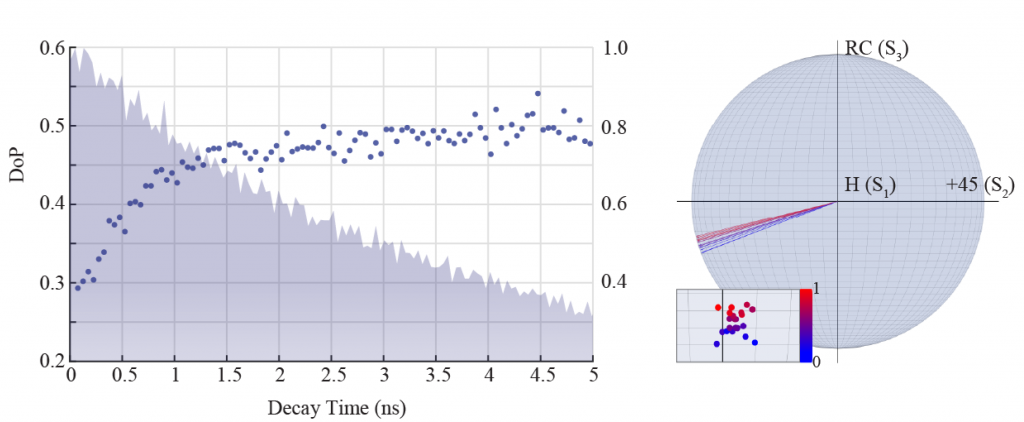 |
| 24. | Ozan Arı; Nahit Polat; Volkan Fırat; Özgür Çakır; Serkan Ateş Temperature-Dependent Spectral Properties of Hexagonal Boron Nitride Color Centers Journal Article ACS Photonics, 2025. @article{Ari.Atess.2025, title = {Temperature-Dependent Spectral Properties of Hexagonal Boron Nitride Color Centers}, author = {Ozan Arı and Nahit Polat and Volkan Fırat and Özgür Çakır and Serkan Ateş}, doi = {10.1021/acsphotonics.4c02616}, year = {2025}, date = {2025-02-27}, journal = {ACS Photonics}, abstract = {Color centers in hexagonal boron nitride (hBN) are emerging as a mature platform for single-photon sources in quantum technology applications. In this study, we investigate the temperature-dependent spectral properties of a single defect in hBN to understand the dominant dephasing mechanisms due to phonons. We observe a sharp zero-phonon line (ZPL) emission accompanied by Stokes and anti-Stokes optical phonon sidebands assisted by the Raman-active low-energy (≈ 6.5 meV) interlayer shear mode of hBN. The shape of the spectral lines around the ZPL is measured down to 78 K, at which the line width of the ZPL is measured as 211 μeV. Using a quadratic electron–phonon interaction, the temperature-dependent broadening and the lineshift of the ZPL are found to follow a temperature dependence of T + T 5 and T + T 3, respectively. Furthermore, the temperature-dependent line shape around the ZPL at low-temperature conditions is modeled with a linear electron–phonon coupling theory, which results in a 0 K Debye–Waller factor of the ZPL emission as 0.59. Our results provide insights into the underlying mechanisms of electron–phonon coupling in hBN, which is critical to enhance their potential for applications in quantum technologies.}, keywords = {}, pubstate = {published}, tppubtype = {article} } Color centers in hexagonal boron nitride (hBN) are emerging as a mature platform for single-photon sources in quantum technology applications. In this study, we investigate the temperature-dependent spectral properties of a single defect in hBN to understand the dominant dephasing mechanisms due to phonons. We observe a sharp zero-phonon line (ZPL) emission accompanied by Stokes and anti-Stokes optical phonon sidebands assisted by the Raman-active low-energy (≈ 6.5 meV) interlayer shear mode of hBN. The shape of the spectral lines around the ZPL is measured down to 78 K, at which the line width of the ZPL is measured as 211 μeV. Using a quadratic electron–phonon interaction, the temperature-dependent broadening and the lineshift of the ZPL are found to follow a temperature dependence of T + T 5 and T + T 3, respectively. Furthermore, the temperature-dependent line shape around the ZPL at low-temperature conditions is modeled with a linear electron–phonon coupling theory, which results in a 0 K Debye–Waller factor of the ZPL emission as 0.59. Our results provide insights into the underlying mechanisms of electron–phonon coupling in hBN, which is critical to enhance their potential for applications in quantum technologies. | 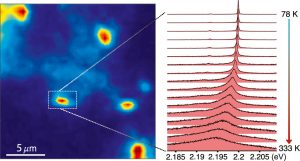 |
| 23. | Aslı Çakan; Chanaprom Cholsuk; Angus Gale; Mehran Kianinia; Serkan Paçal; Serkan Ateş; Igor Aharonovich; Milos Toth; Tobias Vogl Quantum Optics Applications of Hexagonal Boron Nitride Defects Journal Article Advanced Optical Materials, pp. 2402508, 2025. @article{Çakan2024, title = {Quantum Optics Applications of Hexagonal Boron Nitride Defects}, author = {Aslı Çakan and Chanaprom Cholsuk and Angus Gale and Mehran Kianinia and Serkan Paçal and Serkan Ateş and Igor Aharonovich and Milos Toth and Tobias Vogl}, url = {https://advanced.onlinelibrary.wiley.com/doi/10.1002/adom.202402508}, doi = {10.1002/adom.202402508}, year = {2025}, date = {2025-02-13}, journal = {Advanced Optical Materials}, pages = {2402508}, abstract = {Hexagonal boron nitride (hBN) has emerged as a compelling platform for both classical and quantum technologies. In particular, the past decade has witnessed a surge of novel ideas and developments, which may be overwhelming for newcomers to the field. This review provides an overview of the fundamental concepts and key applications of hBN, including quantum sensing, quantum key distribution, quantum computing, and quantum memory. Additionally, critical experimental and theoretical advances that have expanded the capabilities of hBN are highlighted, in a cohesive and accessible manner. The objective is to equip readers with a comprehensive understanding of the diverse applications of hBN, and provide insights into ongoing research efforts.}, keywords = {}, pubstate = {published}, tppubtype = {article} } Hexagonal boron nitride (hBN) has emerged as a compelling platform for both classical and quantum technologies. In particular, the past decade has witnessed a surge of novel ideas and developments, which may be overwhelming for newcomers to the field. This review provides an overview of the fundamental concepts and key applications of hBN, including quantum sensing, quantum key distribution, quantum computing, and quantum memory. Additionally, critical experimental and theoretical advances that have expanded the capabilities of hBN are highlighted, in a cohesive and accessible manner. The objective is to equip readers with a comprehensive understanding of the diverse applications of hBN, and provide insights into ongoing research efforts. | 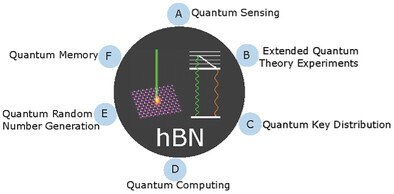 |
| 22. | Anand Kumar; Çağlar Samaner; Chanaprom Cholsuk; Tjorben Matthes; Serkan Paçal; Yağız Oyun; Ashkan Zand; Robert J. Chapman; Grégoire Saerens; Rachel Grange; Sujin Suwanna; Serkan Ateş; Tobias Vogl Polarization Dynamics of Solid-State Quantum Emitters Journal Article ACS Nano, 2024. @article{Caglar2024, title = {Polarization Dynamics of Solid-State Quantum Emitters}, author = {Anand Kumar and Çağlar Samaner and Chanaprom Cholsuk and Tjorben Matthes and Serkan Paçal and Yağız Oyun and Ashkan Zand and Robert J. Chapman and Grégoire Saerens and Rachel Grange and Sujin Suwanna and Serkan Ateş and Tobias Vogl}, url = {https://doi.org/10.1021/acsnano.3c08940}, doi = {10.1021/acsnano.3c08940}, year = {2024}, date = {2024-02-09}, journal = {ACS Nano}, abstract = {Quantum emitters in solid-state crystals have recently attracted a great deal of attention due to their simple applicability in optical quantum technologies. The polarization of single photons generated by quantum emitters is one of the key parameters that plays a crucial role in various applications, such as quantum computation, which uses the indistinguishability of photons. However, the degree of single-photon polarization is typically quantified using the time-averaged photoluminescence intensity of single emitters, which provides limited information about the dipole properties in solids. In this work, we use single defects in hexagonal boron nitride and nanodiamond as efficient room-temperature single-photon sources to reveal the origin and temporal evolution of the dipole orientation in solid-state quantum emitters. The angles of the excitation and emission dipoles relative to the crystal axes were determined experimentally and then calculated using density functional theory, which resulted in characteristic angles for every specific defect that can be used as an efficient tool for defect identification and understanding their atomic structure. Moreover, the temporal polarization dynamics revealed a strongly modified linear polarization visibility that depends on the excited-state decay time of the individual excitation. This effect can potentially be traced back to the excitation of excess charges in the local crystal environment. Understanding such hidden time-dependent mechanisms can further improve the performance of polarization-sensitive experiments, particularly that for quantum communication with single-photon emitters.}, keywords = {}, pubstate = {published}, tppubtype = {article} } Quantum emitters in solid-state crystals have recently attracted a great deal of attention due to their simple applicability in optical quantum technologies. The polarization of single photons generated by quantum emitters is one of the key parameters that plays a crucial role in various applications, such as quantum computation, which uses the indistinguishability of photons. However, the degree of single-photon polarization is typically quantified using the time-averaged photoluminescence intensity of single emitters, which provides limited information about the dipole properties in solids. In this work, we use single defects in hexagonal boron nitride and nanodiamond as efficient room-temperature single-photon sources to reveal the origin and temporal evolution of the dipole orientation in solid-state quantum emitters. The angles of the excitation and emission dipoles relative to the crystal axes were determined experimentally and then calculated using density functional theory, which resulted in characteristic angles for every specific defect that can be used as an efficient tool for defect identification and understanding their atomic structure. Moreover, the temporal polarization dynamics revealed a strongly modified linear polarization visibility that depends on the excited-state decay time of the individual excitation. This effect can potentially be traced back to the excitation of excess charges in the local crystal environment. Understanding such hidden time-dependent mechanisms can further improve the performance of polarization-sensitive experiments, particularly that for quantum communication with single-photon emitters. | 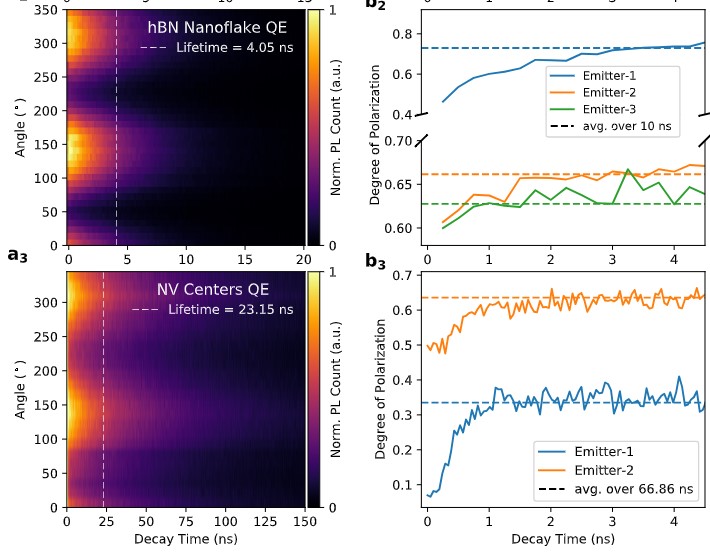 |
| 21. | Çağlar Samaner; Serkan Paçal; Görkem Mutlu; Kıvanç Uyanık; Serkan Ates Free-Space Quantum Key Distribution with Single Photons from Defects in Hexagonal Boron Nitride Journal Article Advanced Quantum Technologies, 5 , 2022. @article{Caglar2022, title = {Free-Space Quantum Key Distribution with Single Photons from Defects in Hexagonal Boron Nitride}, author = {Çağlar Samaner and Serkan Paçal and Görkem Mutlu and Kıvanç Uyanık and Serkan Ates}, url = {https://onlinelibrary.wiley.com/doi/10.1002/qute.202200059}, doi = {10.1002/qute.202200059}, year = {2022}, date = {2022-08-03}, journal = {Advanced Quantum Technologies}, volume = {5}, abstract = {We present a proof-of-concept demonstration of free-space quantum key distribution (QKD) with single photons generated from an isolated defect in hexagonal boron nitride (hBN). The source, operating at room temperature with a 10% brightness, is integrated into a B92 protocol and a secure key rate (SKR) of 238 bps and a quantum bit error rate (QBER) of 8.95% are achieved with 1 MHz clock rate. The effect of temporal filtering of detected photons on the performance of QKD parameters is also studied. We believe that our results will accelerate the work on improving the performance of optically active defects in hBN and their use in high-performance practical QKD systems.}, keywords = {}, pubstate = {published}, tppubtype = {article} } We present a proof-of-concept demonstration of free-space quantum key distribution (QKD) with single photons generated from an isolated defect in hexagonal boron nitride (hBN). The source, operating at room temperature with a 10% brightness, is integrated into a B92 protocol and a secure key rate (SKR) of 238 bps and a quantum bit error rate (QBER) of 8.95% are achieved with 1 MHz clock rate. The effect of temporal filtering of detected photons on the performance of QKD parameters is also studied. We believe that our results will accelerate the work on improving the performance of optically active defects in hBN and their use in high-performance practical QKD systems. |  |
| 20. | K H Madsen; S Ates; J Liu; A Javadi; S M Albrecht; I Yeo; S Stobbe; P Lodahl Efficient out-coupling of high-purity single photons from a coherent quantum dot in a photonic-crystal cavity Journal Article Physical Review B, 90 , pp. 155303, 2014. @article{Madsen2014, title = {Efficient out-coupling of high-purity single photons from a coherent quantum dot in a photonic-crystal cavity}, author = {K H Madsen and S Ates and J Liu and A Javadi and S M Albrecht and I Yeo and S Stobbe and P Lodahl}, url = {http://journals.aps.org/prb/abstract/10.1103/PhysRevB.90.155303}, doi = {10.1103/PhysRevB.90.155303}, year = {2014}, date = {2014-10-06}, journal = {Physical Review B}, volume = {90}, pages = {155303}, abstract = {We demonstrate a single-photon collection efficiency of (44.3±2.1)% from a quantum dot in a low-Q mode of a photonic-crystal cavity with a single-photon purity of g(2)(0)=(4±5)% recorded above the saturation power. The high efficiency is directly confirmed by detecting up to 962±46 kilocounts per second on a single-photon detector on another quantum dot coupled to the cavity mode. The high collection efficiency is found to be broadband, as is explained by detailed numerical simulations. Cavity-enhanced efficient excitation of quantum dots is obtained through phonon-mediated excitation and under these conditions, single-photon indistinguishability measurements reveal long coherence times reaching 0.77±0.19 ns in a weak-excitation regime. Our work demonstrates that photonic crystals provide a very promising platform for highly integrated generation of coherent single photons including the efficient out-coupling of the photons from the photonic chip.}, keywords = {}, pubstate = {published}, tppubtype = {article} } We demonstrate a single-photon collection efficiency of (44.3±2.1)% from a quantum dot in a low-Q mode of a photonic-crystal cavity with a single-photon purity of g(2)(0)=(4±5)% recorded above the saturation power. The high efficiency is directly confirmed by detecting up to 962±46 kilocounts per second on a single-photon detector on another quantum dot coupled to the cavity mode. The high collection efficiency is found to be broadband, as is explained by detailed numerical simulations. Cavity-enhanced efficient excitation of quantum dots is obtained through phonon-mediated excitation and under these conditions, single-photon indistinguishability measurements reveal long coherence times reaching 0.77±0.19 ns in a weak-excitation regime. Our work demonstrates that photonic crystals provide a very promising platform for highly integrated generation of coherent single photons including the efficient out-coupling of the photons from the photonic chip. | 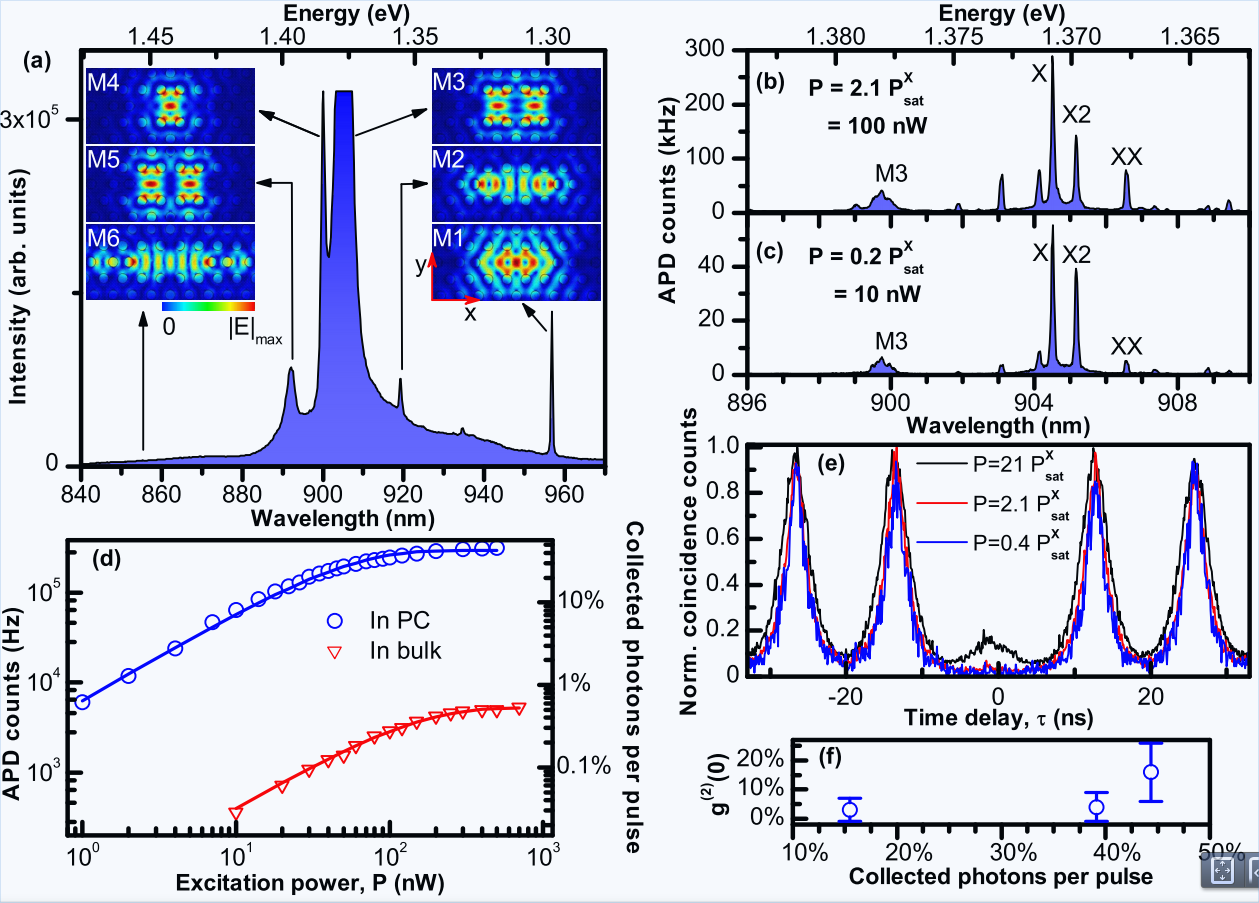 |
| 19. | I Agha; S Ates; L Sapienza; K Srinivasan Spectral broadening and shaping of nanosecond pulses: toward shaping of single photons from quantum emitters Journal Article Optics Letters, 39 (19), pp. 5677-5680, 2014. @article{Agha2014, title = {Spectral broadening and shaping of nanosecond pulses: toward shaping of single photons from quantum emitters}, author = {I Agha and S Ates and L Sapienza and K Srinivasan}, url = {https://www.osapublishing.org/ol/abstract.cfm?uri=ol-39-19-5677}, doi = {10.1364/OL.39.005677}, year = {2014}, date = {2014-09-25}, journal = {Optics Letters}, volume = {39}, number = {19}, pages = {5677-5680}, abstract = {We experimentally demonstrate spectral broadening and shaping of exponentially-decaying nanosecond pulses via nonlinear mixing with a phase-modulated pump in a periodically poled lithium niobate (PPLN) waveguide. 1550 nm pump light is imprinted with a temporal phase and used to upconvert a weak 980 nm pulse to 600 nm while simultaneously broadening the spectrum to that of a Lorentzian pulse up to 10 times shorter. While the current experimental demonstration is for spectral shaping, we also provide a numerical study showing the feasibility of subsequent spectral phase correction to achieve temporal compression and reshaping of a 1 ns mono-exponentially decaying pulse to a 250 ps Lorentzian, which would constitute a complete spectrotemporal waveform shaping protocol. This method, which uses quantum frequency conversion in PPLN with >100∶1 signal-to-noise ratio, is compatible with single photon states of light.}, keywords = {}, pubstate = {published}, tppubtype = {article} } We experimentally demonstrate spectral broadening and shaping of exponentially-decaying nanosecond pulses via nonlinear mixing with a phase-modulated pump in a periodically poled lithium niobate (PPLN) waveguide. 1550 nm pump light is imprinted with a temporal phase and used to upconvert a weak 980 nm pulse to 600 nm while simultaneously broadening the spectrum to that of a Lorentzian pulse up to 10 times shorter. While the current experimental demonstration is for spectral shaping, we also provide a numerical study showing the feasibility of subsequent spectral phase correction to achieve temporal compression and reshaping of a 1 ns mono-exponentially decaying pulse to a 250 ps Lorentzian, which would constitute a complete spectrotemporal waveform shaping protocol. This method, which uses quantum frequency conversion in PPLN with >100∶1 signal-to-noise ratio, is compatible with single photon states of light. | 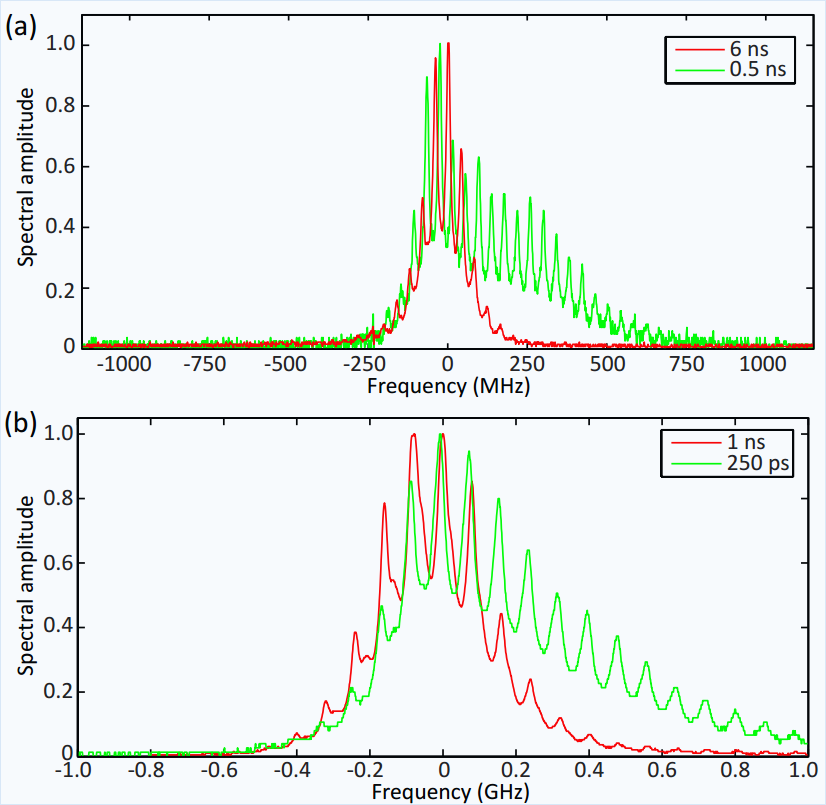 |
| 18. | M Davanço; C S Hellberg; S Ates; A Badolato; K Srinivasan Multiple time scale blinking in InAs quantum dot single-photon sources Journal Article Physical Review B, 89 , pp. 161303(R), 2014. @article{Davanço2014b, title = {Multiple time scale blinking in InAs quantum dot single-photon sources}, author = {M Davanço and C S Hellberg and S Ates and A Badolato and K Srinivasan}, url = {http://journals.aps.org/prb/abstract/10.1103/PhysRevB.89.161303}, doi = {10.1103/PhysRevB.89.161303}, year = {2014}, date = {2014-04-16}, journal = {Physical Review B}, volume = {89}, pages = {161303(R)}, abstract = {We use photon correlation measurements to study blinking in single, epitaxially grown self-assembled InAs quantum dots situated in circular Bragg grating and microdisk cavities. The normalized second-order correlation function g(2)(τ) is studied across 11 orders of magnitude in time, and shows signatures of blinking over time scales ranging from tens of nanoseconds to tens of milliseconds. The g(2)(τ) data is fit to a multilevel system rate equation model that includes multiple nonradiating (dark) states, from which radiative quantum yields significantly less than 1 are obtained. This behavior is observed even in situations for which a direct histogramming analysis of the emission time-trace data produces inconclusive results.}, keywords = {}, pubstate = {published}, tppubtype = {article} } We use photon correlation measurements to study blinking in single, epitaxially grown self-assembled InAs quantum dots situated in circular Bragg grating and microdisk cavities. The normalized second-order correlation function g(2)(τ) is studied across 11 orders of magnitude in time, and shows signatures of blinking over time scales ranging from tens of nanoseconds to tens of milliseconds. The g(2)(τ) data is fit to a multilevel system rate equation model that includes multiple nonradiating (dark) states, from which radiative quantum yields significantly less than 1 are obtained. This behavior is observed even in situations for which a direct histogramming analysis of the emission time-trace data produces inconclusive results. | 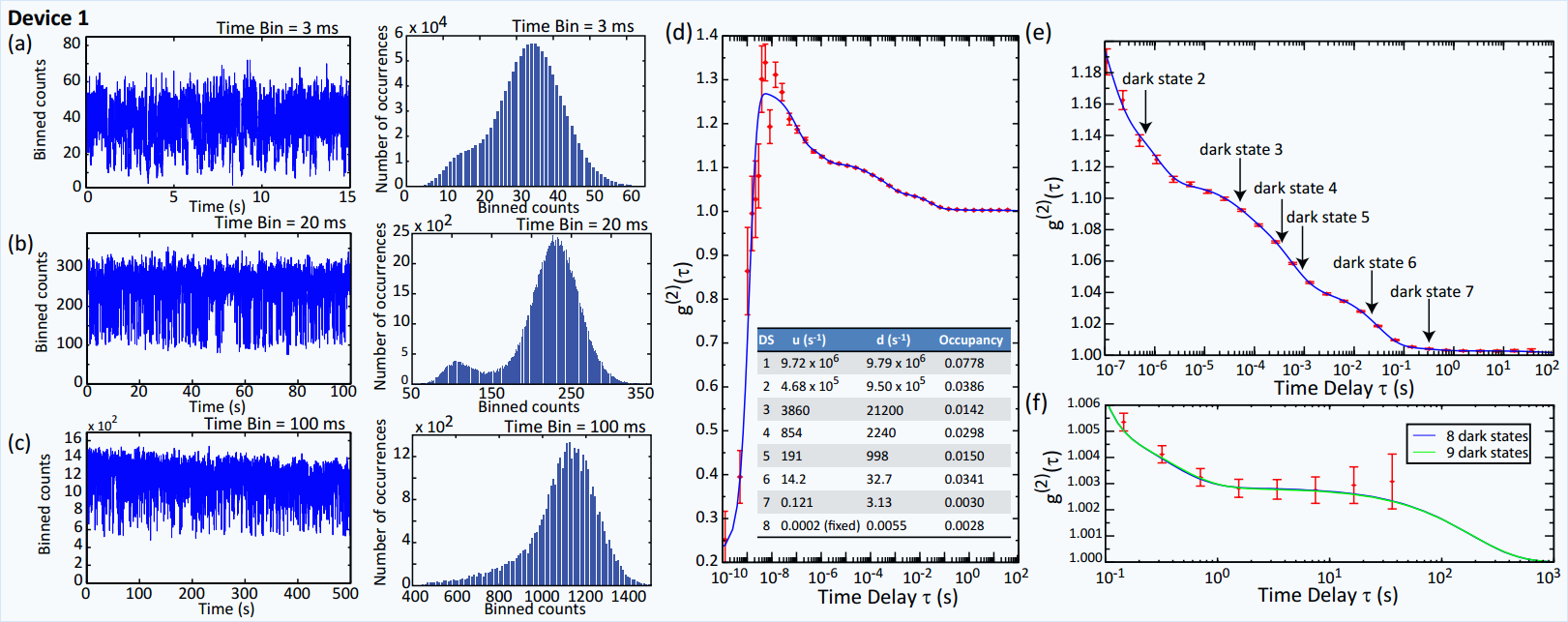 |
| 17. | M Davanço; S Ates; Y Liu; K; Srinivasan Si3N4 optomechanical crystals in the resolved-sideband regime Journal Article Applied Physics Letters, 104 , pp. 041101, 2014. @article{Davanço2014b, title = {Si3N4 optomechanical crystals in the resolved-sideband regime}, author = {M Davanço and S Ates and Y Liu and K and Srinivasan}, url = {http://scitation.aip.org/content/aip/journal/apl/104/4/10.1063/1.4858975}, doi = {10.1063/1.4858975}, year = {2014}, date = {2014-01-27}, journal = {Applied Physics Letters}, volume = {104}, pages = {041101}, abstract = {We demonstrate sideband-resolved Si3N4 optomechanical crystals supporting 10^5 quality factor optical modes at 980 nm, coupled to 4 GHz frequency mechanical modes with quality factors of 3000. Optomechanical electromagnetically induced transparency and absorption are observed at room temperature and in atmosphere with intracavity photon numbers in excess of 10^4.}, keywords = {}, pubstate = {published}, tppubtype = {article} } We demonstrate sideband-resolved Si3N4 optomechanical crystals supporting 10^5 quality factor optical modes at 980 nm, coupled to 4 GHz frequency mechanical modes with quality factors of 3000. Optomechanical electromagnetically induced transparency and absorption are observed at room temperature and in atmosphere with intracavity photon numbers in excess of 10^4. | 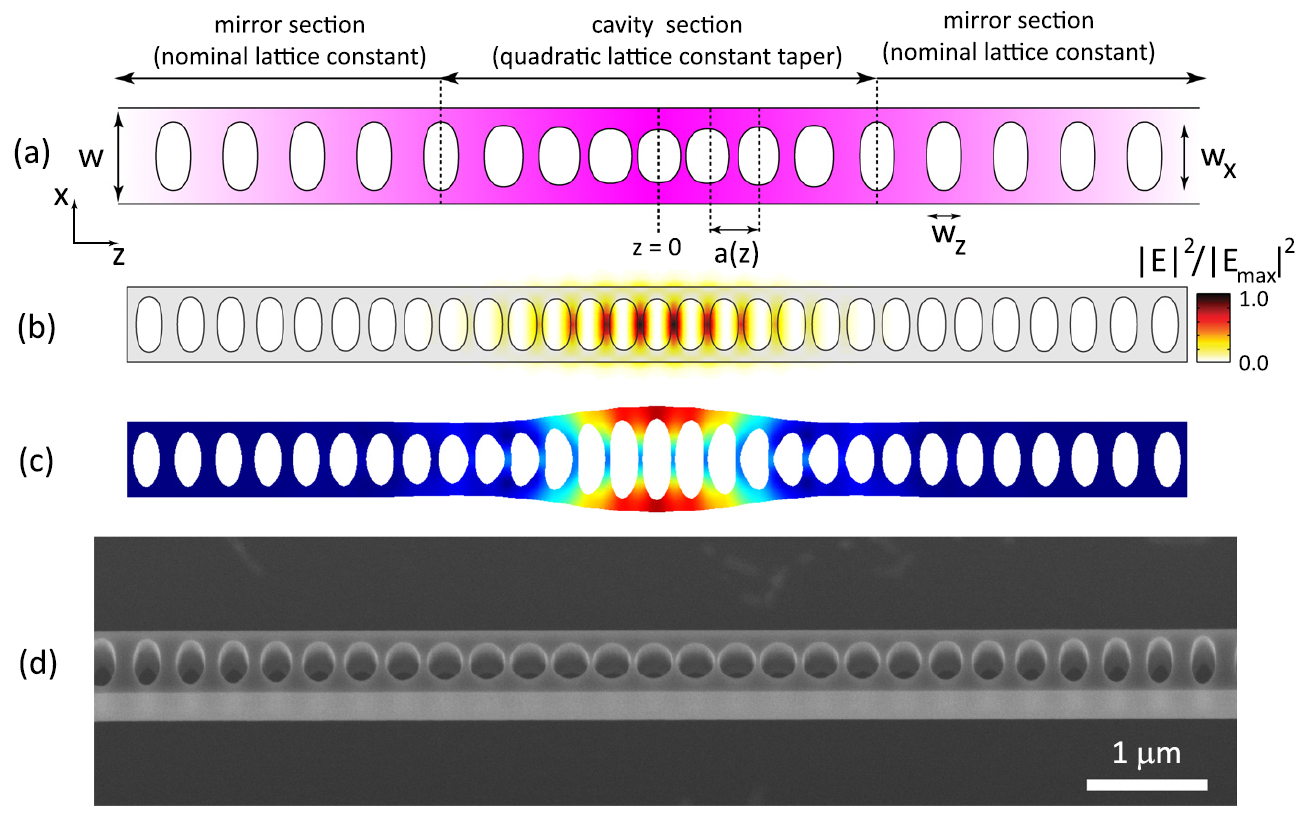 |
| 16. | J Liu; S Ates; M Lorke; J Mørk; P Lodahl; S Stobbe A comparison between experiment and theory on few-quantum-dot nanolasing in a photonic-crystal cavity Journal Article Optics Express, 21 (23), pp. 28507-28512, 2013. @article{Liu2013, title = {A comparison between experiment and theory on few-quantum-dot nanolasing in a photonic-crystal cavity}, author = {J Liu and S Ates and M Lorke and J Mørk and P Lodahl and S Stobbe}, url = {https://www.osapublishing.org/oe/fulltext.cfm?uri=oe-21-23-28507&id=274446}, doi = {10.1364/OE.21.028507}, year = {2013}, date = {2013-11-12}, journal = {Optics Express}, volume = {21}, number = {23}, pages = {28507-28512}, abstract = {We present an experimental and theoretical study on the gain mechanism in a photonic-crystal-cavity nanolaser with embedded quantum dots. From time-resolved measurements at low excitation power we find that four excitons are coupled to the cavity. At high excitation power we observe a smooth low-threshold transition from spontaneous emission to lasing. Before lasing emission sets in, however, the excitons are observed to saturate, and the gain required for lasing originates rather from multi-excitonic transitions, which give rise to a broad emission background. We compare the experiment to a model of quantum-dot microcavity lasers and find that the number of excitons that must be included to fit the data largely exceeds the measured number, which shows that transitions involving the wetting layer can provide a surprisingly large contribution to the gain}, keywords = {}, pubstate = {published}, tppubtype = {article} } We present an experimental and theoretical study on the gain mechanism in a photonic-crystal-cavity nanolaser with embedded quantum dots. From time-resolved measurements at low excitation power we find that four excitons are coupled to the cavity. At high excitation power we observe a smooth low-threshold transition from spontaneous emission to lasing. Before lasing emission sets in, however, the excitons are observed to saturate, and the gain required for lasing originates rather from multi-excitonic transitions, which give rise to a broad emission background. We compare the experiment to a model of quantum-dot microcavity lasers and find that the number of excitons that must be included to fit the data largely exceeds the measured number, which shows that transitions involving the wetting layer can provide a surprisingly large contribution to the gain | 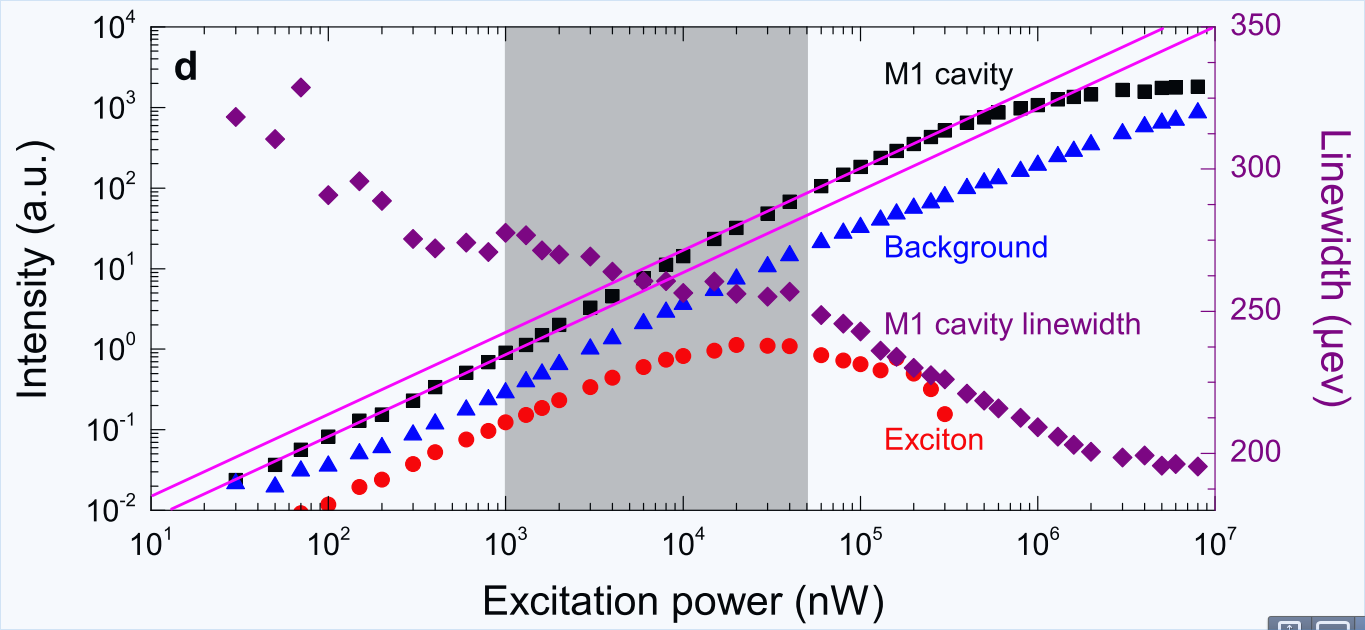 |
| 15. | I Agha; S Ates; M Davanço; K Srinivasan A chip-scale, telecommunications-band frequency conversion interface for quantum emitters Journal Article Optics Express, 21 (18), pp. 21628-21638, 2013. @article{Agha2013, title = {A chip-scale, telecommunications-band frequency conversion interface for quantum emitters}, author = {I Agha and S Ates and M Davanço and K Srinivasan}, url = {https://www.osapublishing.org/oe/fulltext.cfm?uri=oe-21-18-21628&id=260988}, doi = {10.1364/OE.21.021628}, year = {2013}, date = {2013-09-06}, journal = {Optics Express}, volume = {21}, number = {18}, pages = {21628-21638}, abstract = {We describe a chip-scale, telecommunications-band frequency conversion interface designed for low-noise operation at wavelengths desirable for common single photon emitters. Four-wave-mixing Bragg scattering in silicon nitride waveguides is used to demonstrate frequency upconversion and downconversion between the 980 nm and 1550 nm wavelength regions, with signal-to-background levels > 10 and conversion efficiency of ≈ −60 dB at low continuous wave input pump powers (< 50 mW). Finite element simulations and the split-step Fourier method indicate that increased input powers of ≈10 W (produced by amplified nanosecond pulses, for example) will result in a conversion efficiency > 25 % in existing geometries. Finally, we present waveguide designs that can be used to connect shorter wavelength (637 nm to 852 nm) quantum emitters with 1550 nm.}, keywords = {}, pubstate = {published}, tppubtype = {article} } We describe a chip-scale, telecommunications-band frequency conversion interface designed for low-noise operation at wavelengths desirable for common single photon emitters. Four-wave-mixing Bragg scattering in silicon nitride waveguides is used to demonstrate frequency upconversion and downconversion between the 980 nm and 1550 nm wavelength regions, with signal-to-background levels > 10 and conversion efficiency of ≈ −60 dB at low continuous wave input pump powers (< 50 mW). Finite element simulations and the split-step Fourier method indicate that increased input powers of ≈10 W (produced by amplified nanosecond pulses, for example) will result in a conversion efficiency > 25 % in existing geometries. Finally, we present waveguide designs that can be used to connect shorter wavelength (637 nm to 852 nm) quantum emitters with 1550 nm. | 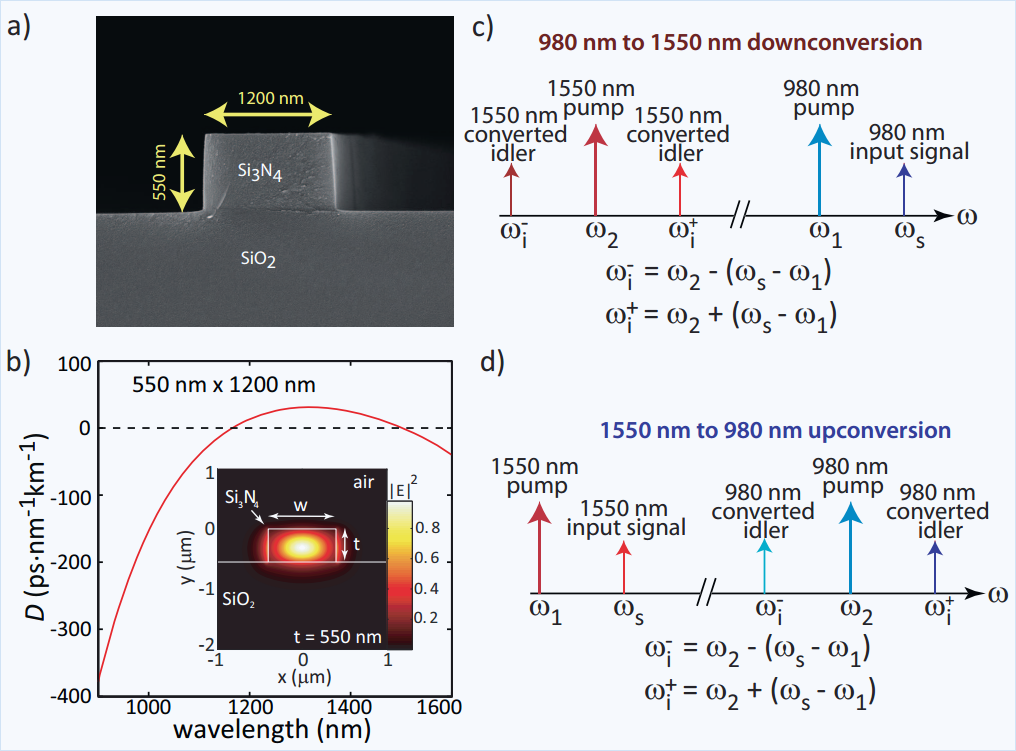 |
| 14. | S Ates; I Agha; A Gulinatti; I Rech; A Badolato; K Srinivasan Improving the performance of bright quantum dot single photon sources using temporal filtering via amplitude modulation Journal Article Scientific Reports, 3 , pp. 1397, 2013. @article{Ates2013, title = {Improving the performance of bright quantum dot single photon sources using temporal filtering via amplitude modulation}, author = {S Ates and I Agha and A Gulinatti and I Rech and A Badolato and K Srinivasan}, url = {http://www.nature.com/articles/srep01397?WT.ec_id=SREP-20130312}, doi = {10.1038/srep01397}, year = {2013}, date = {2013-03-07}, journal = {Scientific Reports}, volume = {3}, pages = {1397}, abstract = {Single epitaxially-grown semiconductor quantum dots have great potential as single photon sources for photonic quantum technologies, though in practice devices often exhibit nonideal behavior. Here, we demonstrate that amplitude modulation can improve the performance of quantum-dot-based sources. Starting with a bright source consisting of a single quantum dot in a fiber-coupled microdisk cavity, we use synchronized amplitude modulation to temporally filter the emitted light. We observe that the single photon purity, temporal overlap between successive emission events, and indistinguishability can be greatly improved with this technique. As this method can be applied to any triggered single photon source, independent of geometry and after device fabrication, it is a flexible approach to improve the performance of systems based on single solid-state quantum emitters, which often suffer from excess dephasing and multi-photon background emission.}, keywords = {}, pubstate = {published}, tppubtype = {article} } Single epitaxially-grown semiconductor quantum dots have great potential as single photon sources for photonic quantum technologies, though in practice devices often exhibit nonideal behavior. Here, we demonstrate that amplitude modulation can improve the performance of quantum-dot-based sources. Starting with a bright source consisting of a single quantum dot in a fiber-coupled microdisk cavity, we use synchronized amplitude modulation to temporally filter the emitted light. We observe that the single photon purity, temporal overlap between successive emission events, and indistinguishability can be greatly improved with this technique. As this method can be applied to any triggered single photon source, independent of geometry and after device fabrication, it is a flexible approach to improve the performance of systems based on single solid-state quantum emitters, which often suffer from excess dephasing and multi-photon background emission. | 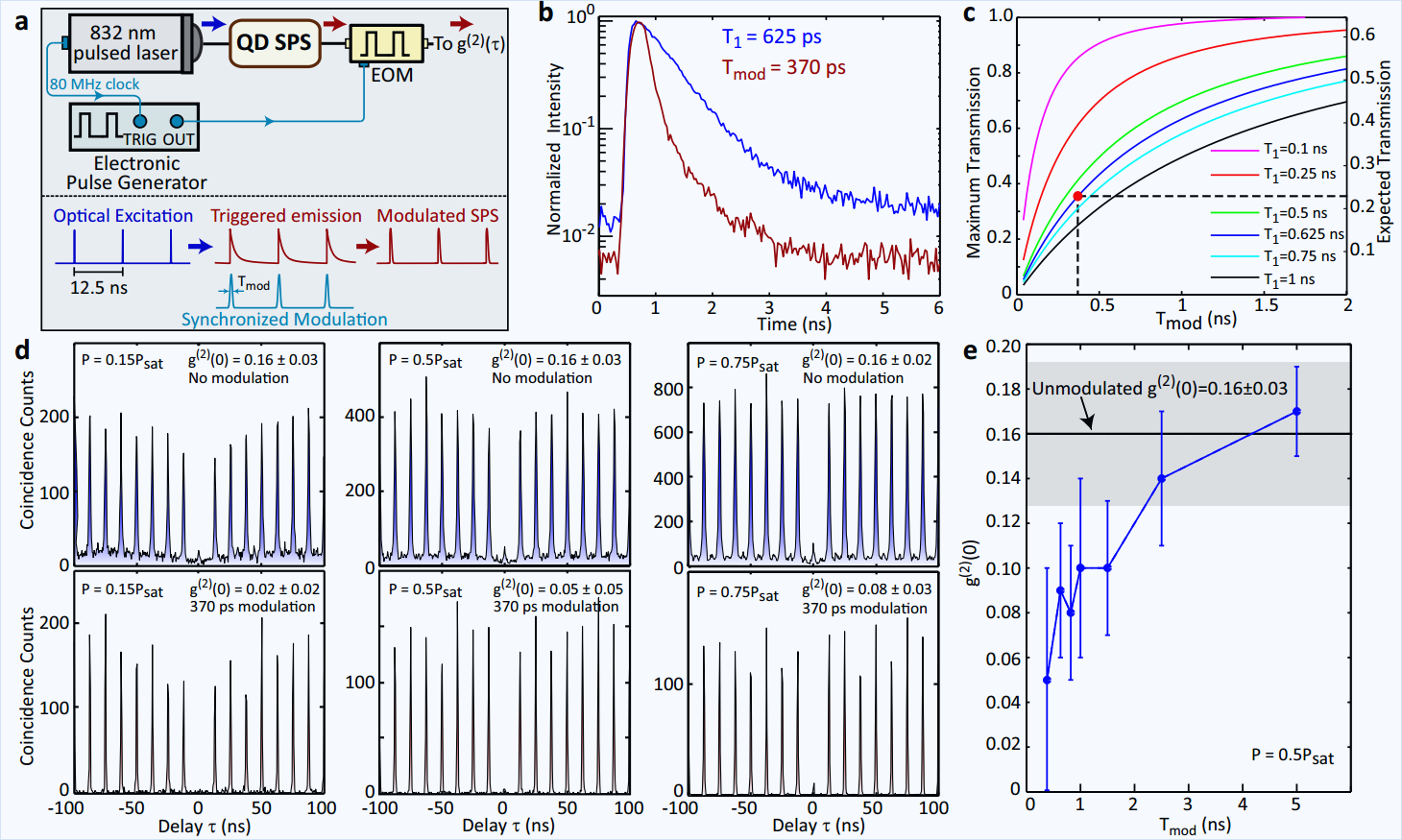 |
| 13. | S Ates; I Agha; A Gulinatti; I Rech; M T Rakher; A Badolato; K Srinivasan Two-Photon Interference Using Background-Free Quantum Frequency Conversion of Single Photons Emitted by an InAs Quantum Dot Journal Article Physical Review Letters, 109 , pp. 147405, 2012. @article{Ates2012, title = {Two-Photon Interference Using Background-Free Quantum Frequency Conversion of Single Photons Emitted by an InAs Quantum Dot}, author = {S Ates and I Agha and A Gulinatti and I Rech and M T Rakher and A Badolato and K Srinivasan}, url = {http://journals.aps.org/prl/abstract/10.1103/PhysRevLett.109.147405}, doi = {10.1103/PhysRevLett.109.147405}, year = {2012}, date = {2012-10-04}, journal = {Physical Review Letters}, volume = {109}, pages = {147405}, abstract = {We show that quantum frequency conversion (QFC) can overcome the spectral distinguishability common to inhomogeneously broadened solid-state quantum emitters. QFC is implemented by combining single photons from an InAs/GaAs quantum dot (QD) at 980 nm with a 1550 nm pump laser in a periodically poled lithium niobate (PPLN) waveguide to generate photons at 600 nm with a signal-to-background ratio exceeding 100∶1. Photon correlation and two-photon interference measurements confirm that both the single photon character and wave packet interference of individual QD states are preserved during frequency conversion. Finally, we convert two spectrally separate QD transitions to the same wavelength in a single PPLN waveguide and show that the resulting field exhibits nonclassical two-photon interference.}, keywords = {}, pubstate = {published}, tppubtype = {article} } We show that quantum frequency conversion (QFC) can overcome the spectral distinguishability common to inhomogeneously broadened solid-state quantum emitters. QFC is implemented by combining single photons from an InAs/GaAs quantum dot (QD) at 980 nm with a 1550 nm pump laser in a periodically poled lithium niobate (PPLN) waveguide to generate photons at 600 nm with a signal-to-background ratio exceeding 100∶1. Photon correlation and two-photon interference measurements confirm that both the single photon character and wave packet interference of individual QD states are preserved during frequency conversion. Finally, we convert two spectrally separate QD transitions to the same wavelength in a single PPLN waveguide and show that the resulting field exhibits nonclassical two-photon interference. | 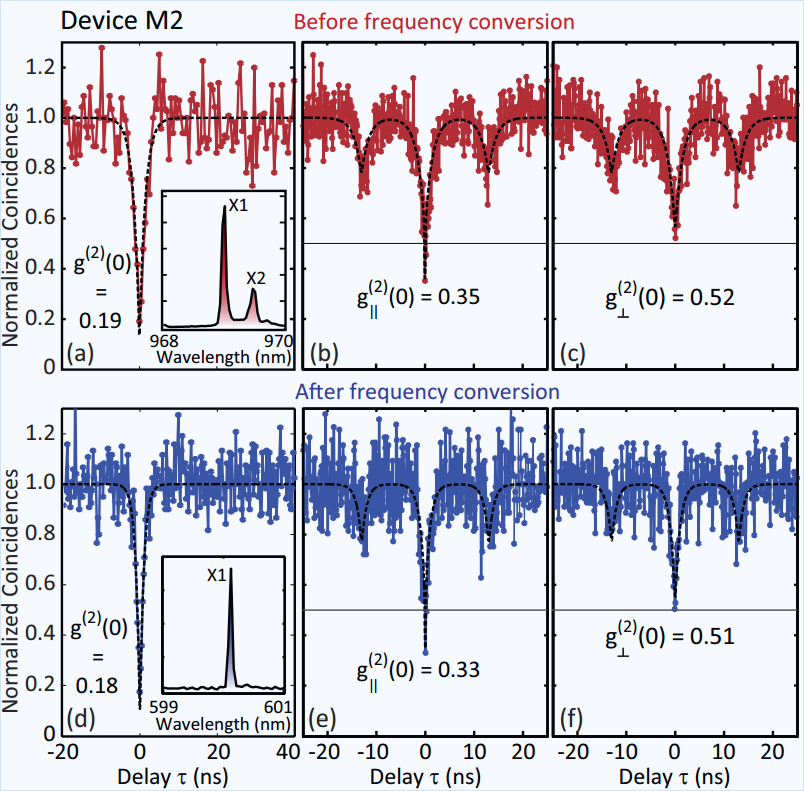 |
| 12. | S Ates; L Sapienza; M Davanco; A Badolato; K Srinivasan Bright Single-Photon Emission From a Quantum Dot in a Circular Bragg Grating Microcavity Journal Article IEEE Journal of Selected Topics in Quantum Electronics, 18 , pp. 1711 - 1721, 2012. @article{Ates2012b, title = {Bright Single-Photon Emission From a Quantum Dot in a Circular Bragg Grating Microcavity}, author = {S Ates and L Sapienza and M Davanco and A Badolato and K Srinivasan}, url = {http://ieeexplore.ieee.org/xpl/articleDetails.jsp?tp=&arnumber=6179507&url=http%3A%2F%2Fieeexplore.ieee.org%2Fxpls%2Fabs_all.jsp%3Farnumber%3D6179507}, doi = {10.1109/JSTQE.2012.2193877}, year = {2012}, date = {2012-04-06}, journal = {IEEE Journal of Selected Topics in Quantum Electronics}, volume = {18}, pages = {1711 - 1721}, abstract = {Bright single-photon emission from single quantum dots (QDs) in suspended circular Bragg grating microcavities is demonstrated. This geometry has been designed to achieve efficient (>; 50%) single-photon extraction into a near-Gaussian-shaped far-field pattern, modest (≈ 10 ×) Purcell enhancement of the radiative rate, and a spectral bandwidth of a few nanometers. Measurements of fabricated devices show progress toward these goals, with collection efficiencies as high as ≈ 10% demonstrated with moderate spectral bandwidth and rate enhancement. Photon correlation measurements are performed under above-bandgap excitation (pump wavelength = 780 to 820 nm) and confirm the single-photon character of the collected emission. While the measured sources are all antibunched and dominantly composed of single photons, the multiphoton probability varies significantly. Devices exhibiting tradeoffs among collection efficiency, Purcell enhancement, and multiphoton probability are explored and the results are interpreted with the help of finite-difference time-domain simulations. Below-bandgap excitation resonant with higher states of the QD and/or cavity (pump wavelength = 860 to 900 nm) shows a near-complete suppression of multiphoton events and may circumvent some of the aforementioned tradeoffs.}, keywords = {}, pubstate = {published}, tppubtype = {article} } Bright single-photon emission from single quantum dots (QDs) in suspended circular Bragg grating microcavities is demonstrated. This geometry has been designed to achieve efficient (>; 50%) single-photon extraction into a near-Gaussian-shaped far-field pattern, modest (≈ 10 ×) Purcell enhancement of the radiative rate, and a spectral bandwidth of a few nanometers. Measurements of fabricated devices show progress toward these goals, with collection efficiencies as high as ≈ 10% demonstrated with moderate spectral bandwidth and rate enhancement. Photon correlation measurements are performed under above-bandgap excitation (pump wavelength = 780 to 820 nm) and confirm the single-photon character of the collected emission. While the measured sources are all antibunched and dominantly composed of single photons, the multiphoton probability varies significantly. Devices exhibiting tradeoffs among collection efficiency, Purcell enhancement, and multiphoton probability are explored and the results are interpreted with the help of finite-difference time-domain simulations. Below-bandgap excitation resonant with higher states of the QD and/or cavity (pump wavelength = 860 to 900 nm) shows a near-complete suppression of multiphoton events and may circumvent some of the aforementioned tradeoffs. | 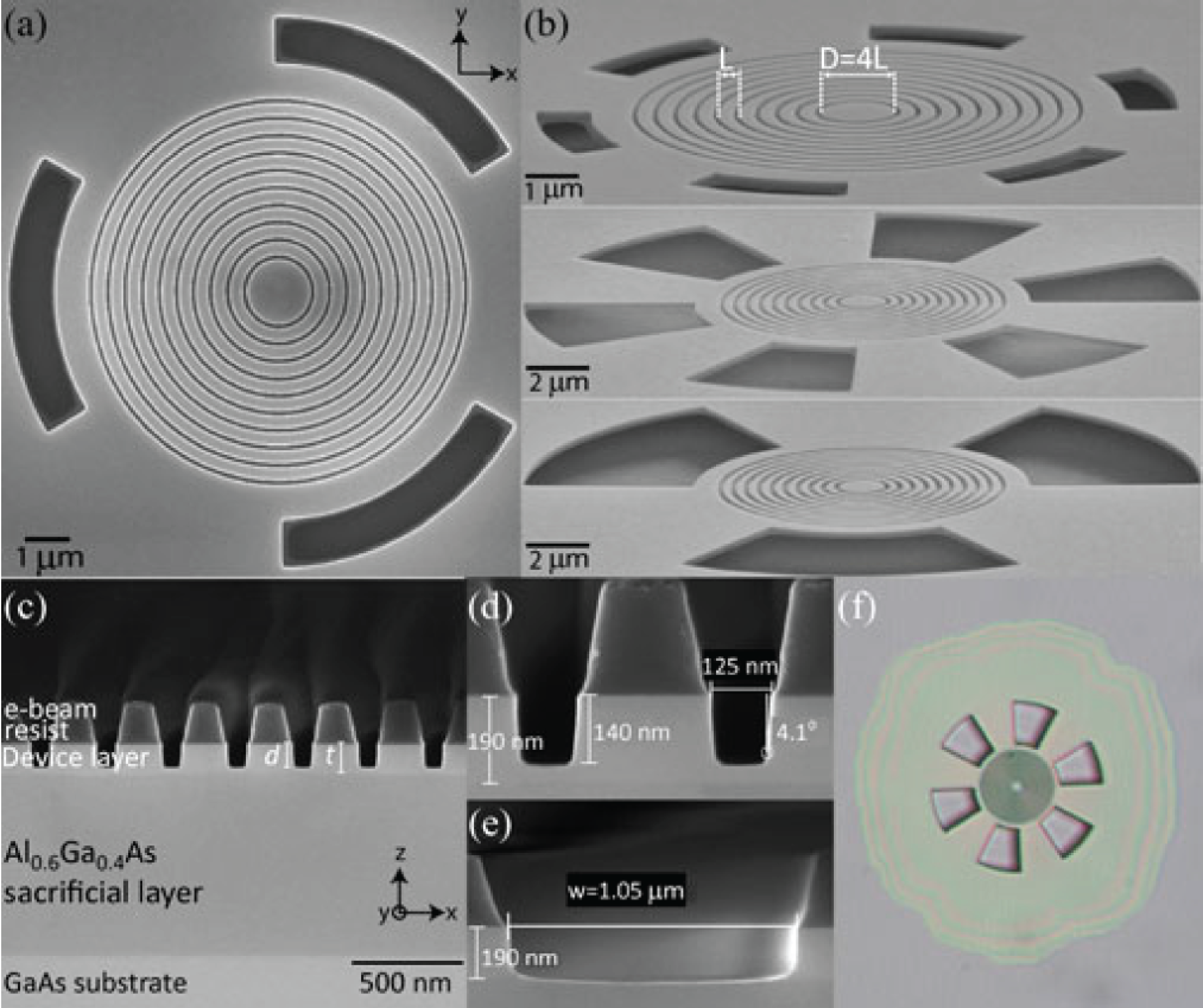 |
| 11. | S M Ulrich; S Ates; S Reitzenstein; A Löffler; A Forchel; P Michler Dephasing of Triplet-Sideband Optical Emission of a Resonantly Driven InAs/GaAs Quantum Dot inside a Microcavity Journal Article Physical Review Letters, 106 , pp. 247402, 2011. @article{Ulrich2011, title = {Dephasing of Triplet-Sideband Optical Emission of a Resonantly Driven InAs/GaAs Quantum Dot inside a Microcavity}, author = {S M Ulrich and S Ates and S Reitzenstein and A Löffler and A Forchel and P Michler}, url = {http://journals.aps.org/prl/abstract/10.1103/PhysRevLett.106.247402}, doi = {10.1103/PhysRevLett.106.247402}, year = {2011}, date = {2011-06-16}, journal = {Physical Review Letters}, volume = {106}, pages = {247402}, abstract = {Detailed properties of resonance fluorescence from a single quantum dot in a micropillar cavity are investigated, with particular focus on emission coherence in the dependence on optical driving field power and detuning. A power-dependent series over a wide range reveals characteristic Mollow triplet spectra with large Rabi splittings of |Ω|≤15 GHz. In particular, the effect of dephasing in terms of systematic spectral broadening ∝Ω2 of the Mollow sidebands is observed as a strong fingerprint of excitation-induced dephasing. Our results are in excellent agreement with predictions of a recently presented model on phonon-dressed quantum dot Mollow triplet emission in the cavity-QED regime.}, keywords = {}, pubstate = {published}, tppubtype = {article} } Detailed properties of resonance fluorescence from a single quantum dot in a micropillar cavity are investigated, with particular focus on emission coherence in the dependence on optical driving field power and detuning. A power-dependent series over a wide range reveals characteristic Mollow triplet spectra with large Rabi splittings of |Ω|≤15 GHz. In particular, the effect of dephasing in terms of systematic spectral broadening ∝Ω2 of the Mollow sidebands is observed as a strong fingerprint of excitation-induced dephasing. Our results are in excellent agreement with predictions of a recently presented model on phonon-dressed quantum dot Mollow triplet emission in the cavity-QED regime. | 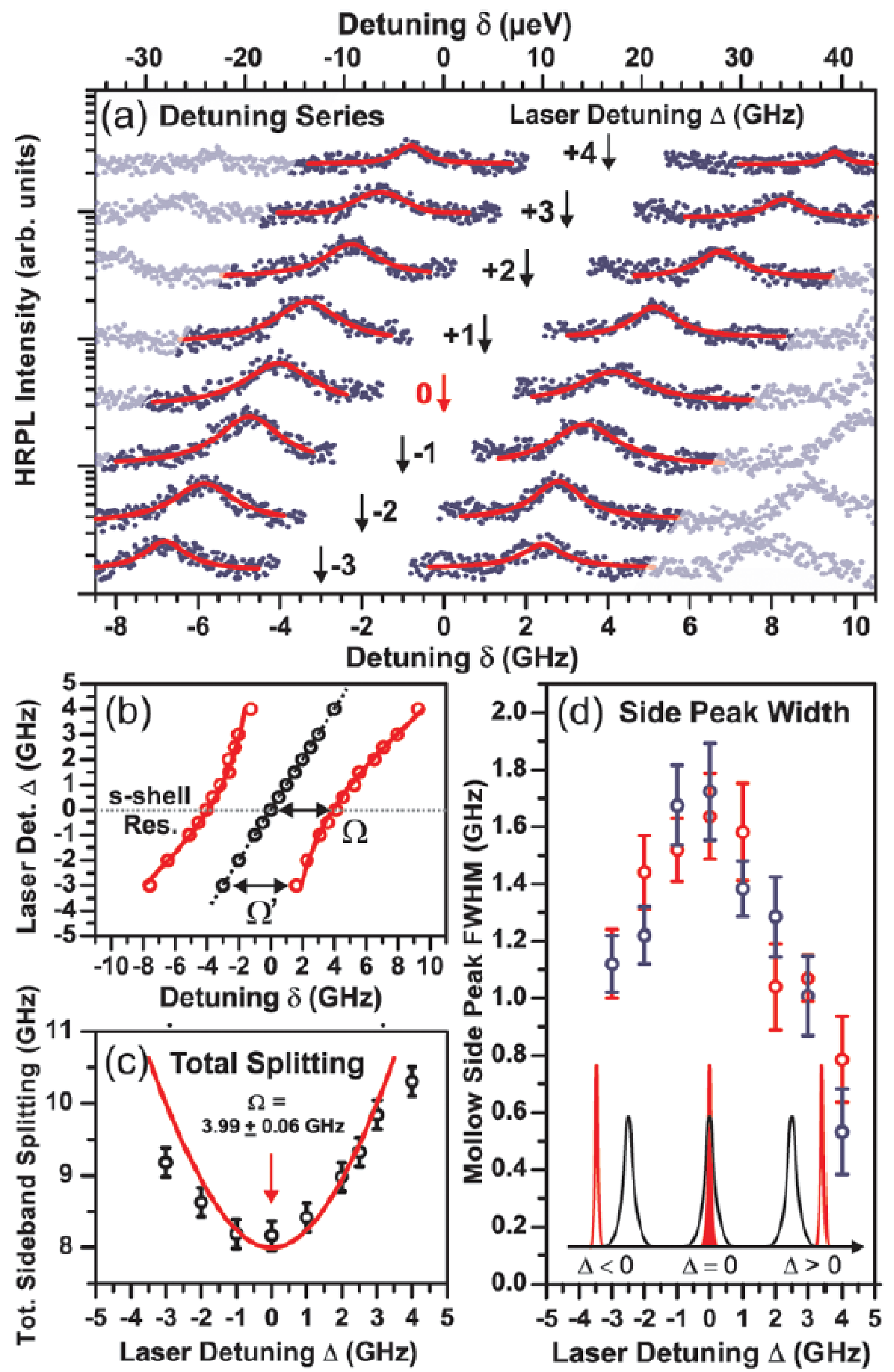 |
| 10. | K H Madsen; S Ates; T Lund-Hansen; A Löffler; S Reitzenstein; A Forchel; P Lodahl Observation of Non-Markovian Dynamics of a Single Quantum Dot in a Micropillar Cavity Journal Article Physical Review Letters, 106 , pp. 233601, 2011. @article{Madsen2011, title = {Observation of Non-Markovian Dynamics of a Single Quantum Dot in a Micropillar Cavity}, author = {K H Madsen and S Ates and T Lund-Hansen and A Löffler and S Reitzenstein and A Forchel and P Lodahl}, url = {http://journals.aps.org/prl/abstract/10.1103/PhysRevLett.106.233601}, doi = {10.1103/PhysRevLett.106.233601}, year = {2011}, date = {2011-06-06}, journal = {Physical Review Letters}, volume = {106}, pages = {233601}, abstract = {We measure the detuning-dependent dynamics of a quasiresonantly excited single quantum dot coupled to a micropillar cavity. The system is modeled with the dissipative Jaynes-Cummings model where all experimental parameters are determined by explicit measurements. We observe non-Markovian dynamics when the quantum dot is tuned into resonance with the cavity leading to a nonexponential decay in time. Excellent agreement between experiment and theory is observed with no free parameters providing the first quantitative description of an all-solid-state cavity QED system based on quantum dot emitters.}, keywords = {}, pubstate = {published}, tppubtype = {article} } We measure the detuning-dependent dynamics of a quasiresonantly excited single quantum dot coupled to a micropillar cavity. The system is modeled with the dissipative Jaynes-Cummings model where all experimental parameters are determined by explicit measurements. We observe non-Markovian dynamics when the quantum dot is tuned into resonance with the cavity leading to a nonexponential decay in time. Excellent agreement between experiment and theory is observed with no free parameters providing the first quantitative description of an all-solid-state cavity QED system based on quantum dot emitters. | 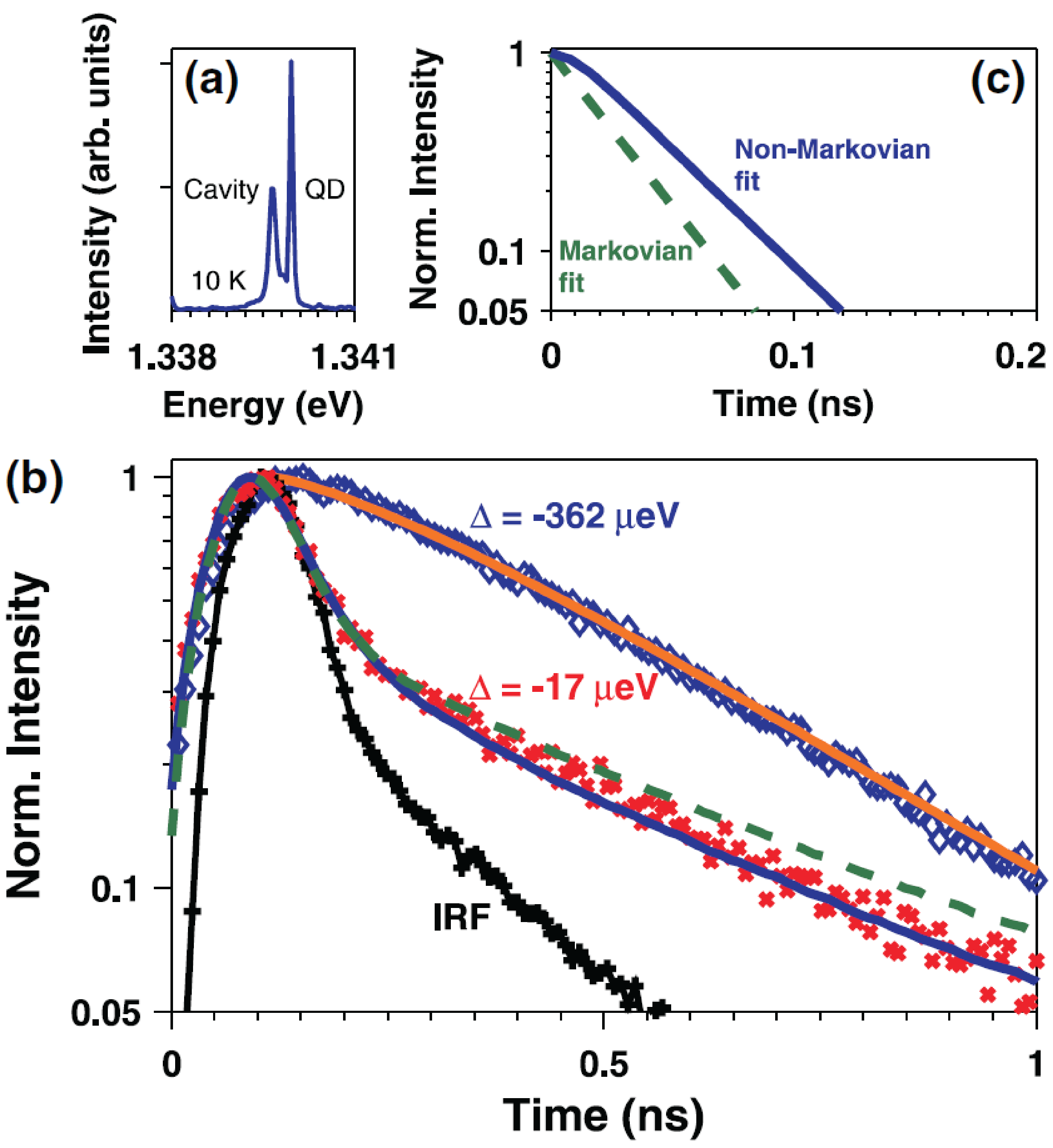 |
| 9. | A Ulhaq; S Ates; S M Ulrich; S Reitzenstein; A Löffler; A Forchel; P Michler Non-resonant cavity-quantum dot coupling Journal Article Journal of Physics: Conference Series, 210 , pp. 012058, 2010. @article{Ulhaq2010b, title = {Non-resonant cavity-quantum dot coupling}, author = {A Ulhaq and S Ates and S M Ulrich and S Reitzenstein and A Löffler and A Forchel and P Michler}, url = {http://iopscience.iop.org/article/10.1088/1742-6596/210/1/012058/meta}, doi = {10.1088/1742-6596/210/1/012058}, year = {2010}, date = {2010-10-13}, journal = {Journal of Physics: Conference Series}, volume = {210}, pages = {012058}, abstract = {Non-resonant cavity-quantum dot coupling is an interesting phenomenon with significant consequences for solid state single-photon sources. Here we present studies on the origin of the coupling mechanism by resonant excitation of single quantum dots in micro-pillar cavities. Furthermore, we demonstrate the non-resonant coupling as a powerful tool to 'monitor' the s-shell properties of a quantum dot by observing the behavior of a detuned coupled cavity mode.}, keywords = {}, pubstate = {published}, tppubtype = {article} } Non-resonant cavity-quantum dot coupling is an interesting phenomenon with significant consequences for solid state single-photon sources. Here we present studies on the origin of the coupling mechanism by resonant excitation of single quantum dots in micro-pillar cavities. Furthermore, we demonstrate the non-resonant coupling as a powerful tool to 'monitor' the s-shell properties of a quantum dot by observing the behavior of a detuned coupled cavity mode. | 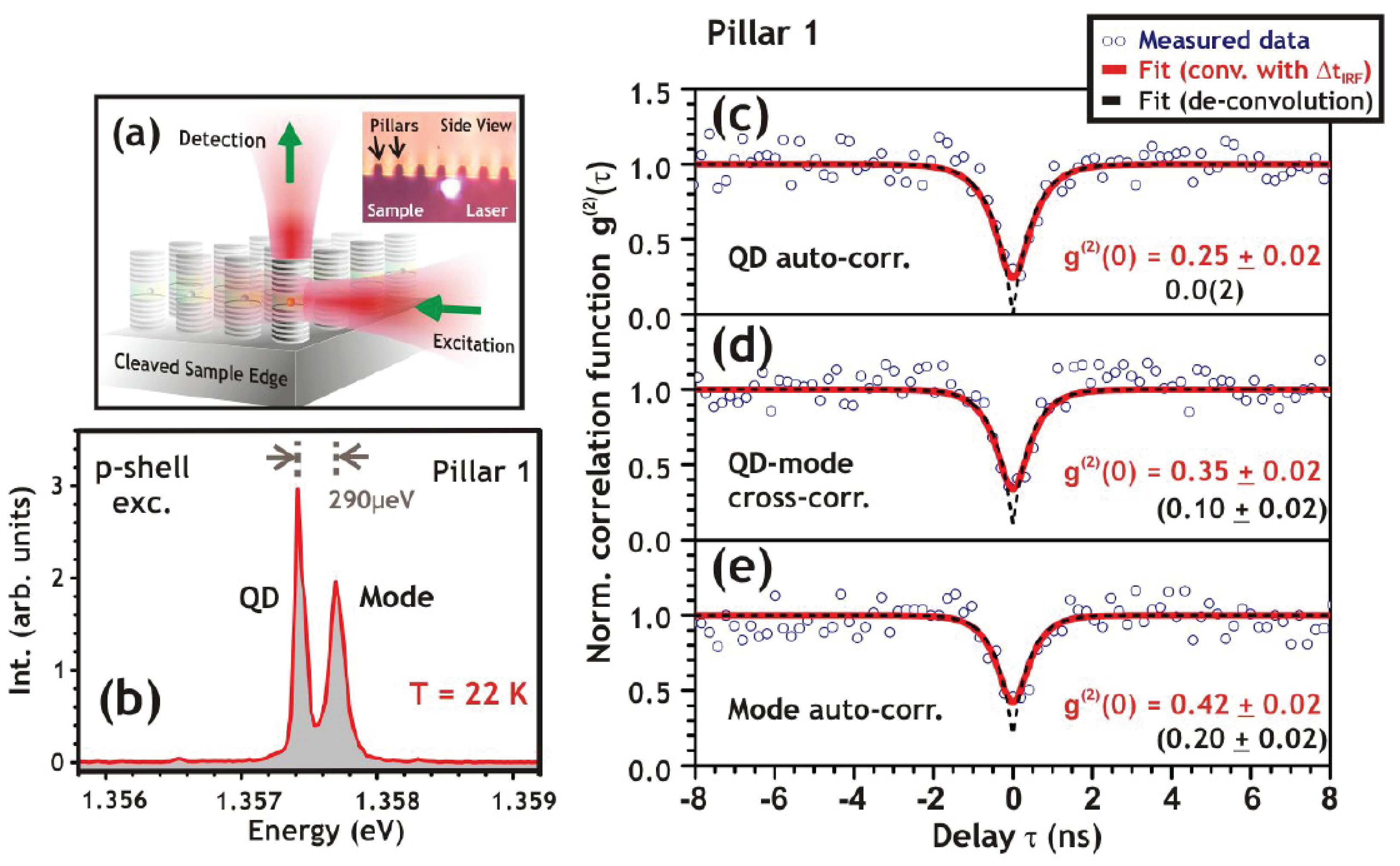 |
| 8. | A Ulhaq; S Ates; S Weiler; S M Ulrich; S Reitzenstein; A Löffler; S Höfling; L Worschech; A Forchel; P Michler Linewidth broadening and emission saturation of a resonantly excited quantum dot monitored via an off-resonant cavity mode Journal Article Physical Review B, 82 , pp. 045307, 2010. @article{Ulhaq2010b, title = {Linewidth broadening and emission saturation of a resonantly excited quantum dot monitored via an off-resonant cavity mode}, author = {A Ulhaq and S Ates and S Weiler and S M Ulrich and S Reitzenstein and A Löffler and S Höfling and L Worschech and A Forchel and P Michler}, url = {http://journals.aps.org/prb/abstract/10.1103/PhysRevB.82.045307}, doi = {10.1103/PhysRevB.82.045307}, year = {2010}, date = {2010-07-12}, journal = {Physical Review B}, volume = {82}, pages = {045307}, abstract = {We report on the robustness of a detuned mode channel for reading out the relevant s-shell properties of a resonantly excited coupled quantum dot (QD) in a pillar microcavity. The line broadening of the QD s-shell is “monitored” by the mode signal with high conformity to the directly measured QD linewidth. The mode signal also monitors the saturation behavior of a near Fourier transform-limited photon emission from a resonantly excited QD. We also investigate the temperature dependence of the coupling mechanism between an off-resonant QD and a cavity mode under pure resonant excitation of the quantum emitter.}, keywords = {}, pubstate = {published}, tppubtype = {article} } We report on the robustness of a detuned mode channel for reading out the relevant s-shell properties of a resonantly excited coupled quantum dot (QD) in a pillar microcavity. The line broadening of the QD s-shell is “monitored” by the mode signal with high conformity to the directly measured QD linewidth. The mode signal also monitors the saturation behavior of a near Fourier transform-limited photon emission from a resonantly excited QD. We also investigate the temperature dependence of the coupling mechanism between an off-resonant QD and a cavity mode under pure resonant excitation of the quantum emitter. | 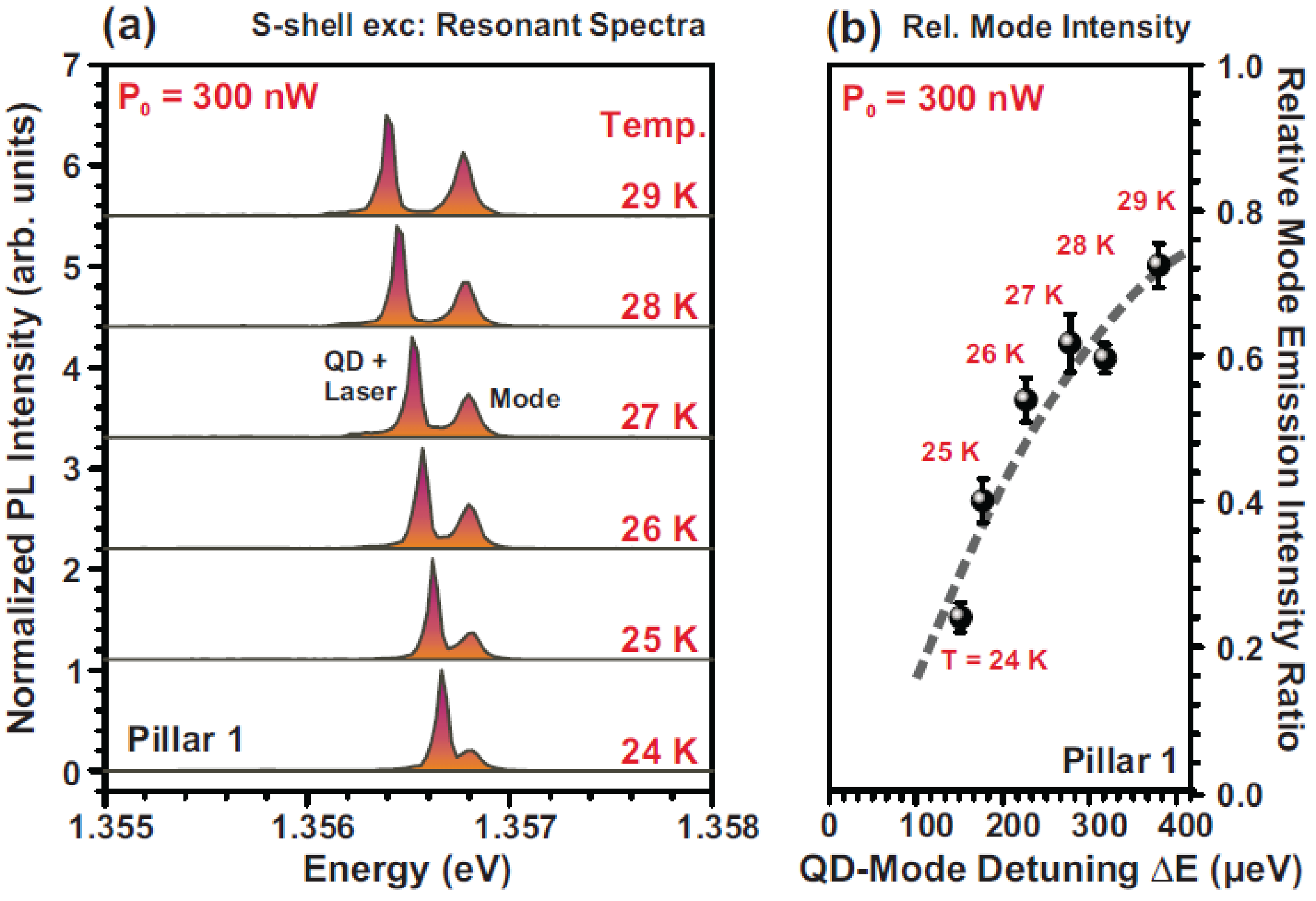 |
| 7. | S Ates; SM Ulrich; A Ulhaq; S Reitzenstein; A Löffler; S Höfling; A Forchel; P Michler Non-resonant dot–cavity coupling and its potential for resonant single-quantum-dot spectroscopy Journal Article Nature Photonics, 3 , pp. 724 - 728, 2009. @article{Ates2009, title = {Non-resonant dot–cavity coupling and its potential for resonant single-quantum-dot spectroscopy}, author = {S Ates and SM Ulrich and A Ulhaq and S Reitzenstein and A Löffler and S Höfling and A Forchel and P Michler}, url = {http://www.nature.com/nphoton/journal/v3/n12/full/nphoton.2009.215.html}, doi = {nphoton.2009.215}, year = {2009}, date = {2009-10-22}, journal = {Nature Photonics}, volume = {3}, pages = {724 - 728}, abstract = {Non-resonant emitter–cavity coupling is a fascinating effect recently observed as unexpected pronounced cavity resonance emission even in strongly detuned single quantum dot–microcavity systems. This phenomenon indicates strong, complex light–matter interactions in these solid-state systems, and has major implications for single-photon sources and quantum information applications. We study non-resonant dot–cavity coupling of individual quantum dots in micropillars under resonant excitation, revealing a pronounced effect over positive and negative quantum dot mode detunings. Our results suggest a dominant role of phonon-mediated dephasing in dot–cavity coupling, giving a new perspective to the controversial discussions ongoing in the literature. Such enhanced insight is essential for various cavity-based quantum electrodynamic systems using emitters that experience phonon coupling, such as colour centres in diamond and colloidal nanocrystals. Non-resonant coupling is demonstrated to be a versatile ‘monitoring’ tool for observing relevant quantum dot s-shell emission properties and background-free photon statistics.}, keywords = {}, pubstate = {published}, tppubtype = {article} } Non-resonant emitter–cavity coupling is a fascinating effect recently observed as unexpected pronounced cavity resonance emission even in strongly detuned single quantum dot–microcavity systems. This phenomenon indicates strong, complex light–matter interactions in these solid-state systems, and has major implications for single-photon sources and quantum information applications. We study non-resonant dot–cavity coupling of individual quantum dots in micropillars under resonant excitation, revealing a pronounced effect over positive and negative quantum dot mode detunings. Our results suggest a dominant role of phonon-mediated dephasing in dot–cavity coupling, giving a new perspective to the controversial discussions ongoing in the literature. Such enhanced insight is essential for various cavity-based quantum electrodynamic systems using emitters that experience phonon coupling, such as colour centres in diamond and colloidal nanocrystals. Non-resonant coupling is demonstrated to be a versatile ‘monitoring’ tool for observing relevant quantum dot s-shell emission properties and background-free photon statistics. | 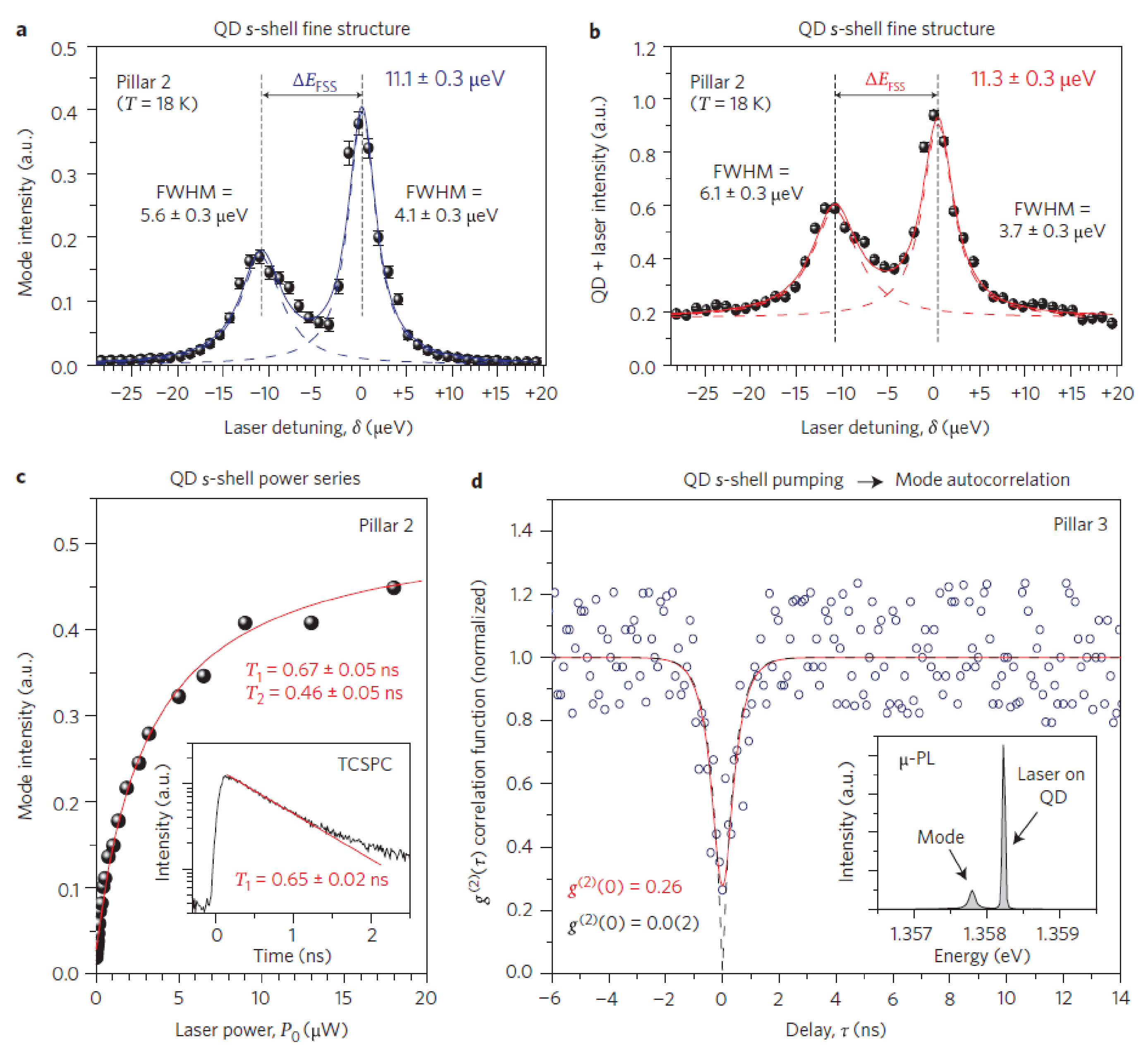 |
| 6. | S Ates; S M Ulrich; S Reitzenstein; A Löffler; A Forchel; P Michler Post-Selected Indistinguishable Photons from the Resonance Fluorescence of a Single Quantum Dot in a Microcavity Journal Article Physical Review Letters, 103 , pp. 167402, 2009. @article{Ates2009b, title = {Post-Selected Indistinguishable Photons from the Resonance Fluorescence of a Single Quantum Dot in a Microcavity}, author = {S Ates and S M Ulrich and S Reitzenstein and A Löffler and A Forchel and P Michler}, url = {http://journals.aps.org/prl/abstract/10.1103/PhysRevLett.103.167402}, doi = {10.1103/PhysRevLett.103.167402}, year = {2009}, date = {2009-10-16}, journal = {Physical Review Letters}, volume = {103}, pages = {167402}, abstract = {Applying continuous-wave pure resonant s-shell optical excitation of individual quantum dots in a high-quality micropillar cavity, we demonstrate the generation of post-selected indistinguishable photons in resonance fluorescence. Close to ideal visibility contrast of 90% is verified by polarization-dependent Hong-Ou-Mandel two-photon interference measurements. Furthermore, a strictly resonant continuous-wave excitation together with controlling the spontaneous emission lifetime of the single quantum dots via tunable emitter-mode coupling (Purcell) is proven as a versatile scheme to generate close to Fourier transform-limited (T2/(2T1)=0.91) single photons even at 80% of the emission saturation level.}, keywords = {}, pubstate = {published}, tppubtype = {article} } Applying continuous-wave pure resonant s-shell optical excitation of individual quantum dots in a high-quality micropillar cavity, we demonstrate the generation of post-selected indistinguishable photons in resonance fluorescence. Close to ideal visibility contrast of 90% is verified by polarization-dependent Hong-Ou-Mandel two-photon interference measurements. Furthermore, a strictly resonant continuous-wave excitation together with controlling the spontaneous emission lifetime of the single quantum dots via tunable emitter-mode coupling (Purcell) is proven as a versatile scheme to generate close to Fourier transform-limited (T2/(2T1)=0.91) single photons even at 80% of the emission saturation level. | 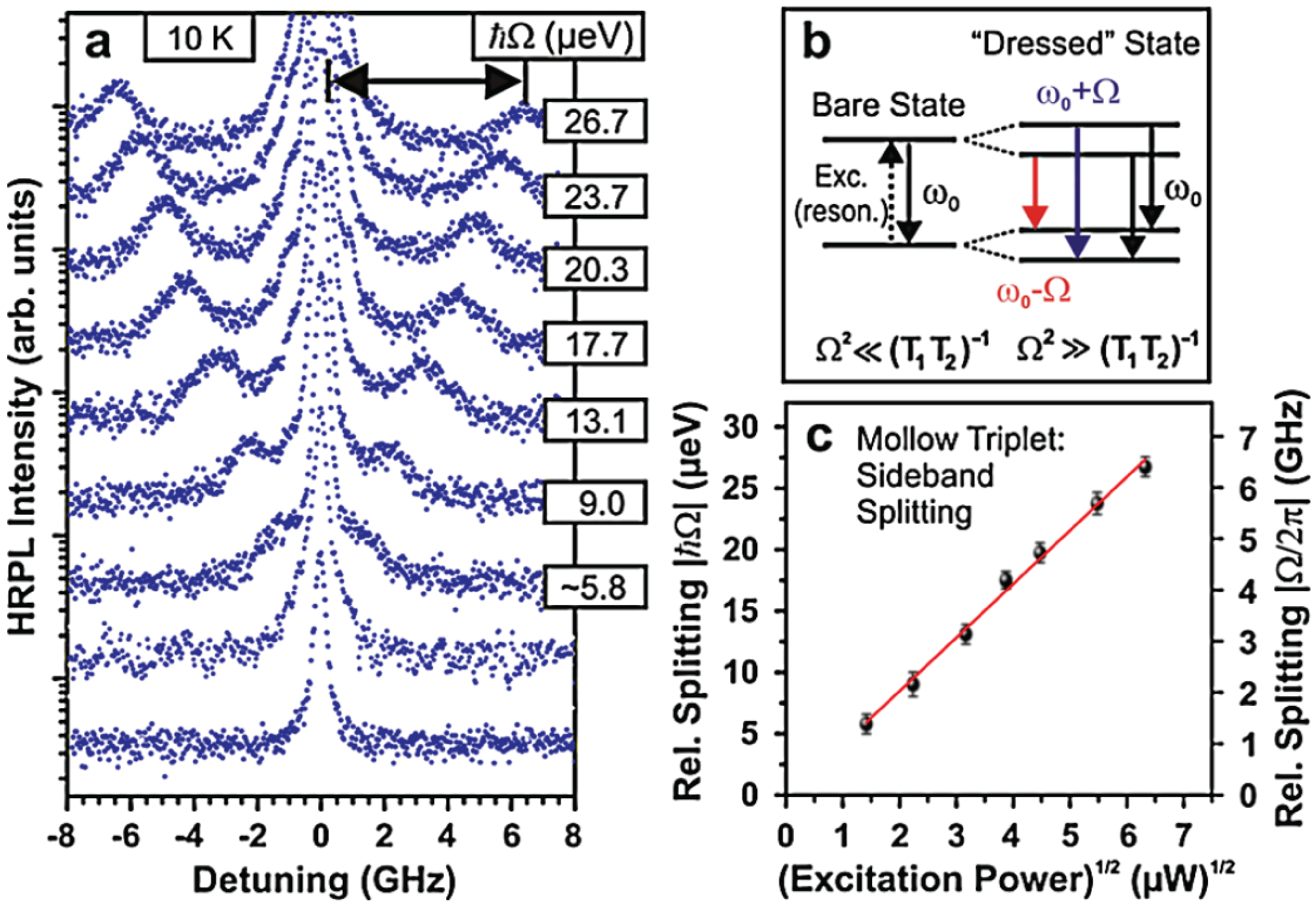 |
| 5. | S Ates; C Gies; S M Ulrich; J Wiersig; S Reitzenstein; A Löffler; A Forchel; F Jahnke; P Michler Coherence length of high-β semiconductor microcavity lasers Conference Phys. Status Solidi C, 6 (2), 2008. @conference{Ates2008b, title = {Coherence length of high-β semiconductor microcavity lasers}, author = {S Ates and C Gies and S M Ulrich and J Wiersig and S Reitzenstein and A Löffler and A Forchel and F Jahnke and P Michler}, url = {http://onlinelibrary.wiley.com/doi/10.1002/pssc.200880332/abstract}, doi = {10.1002/pssc.200880332}, year = {2008}, date = {2008-10-28}, booktitle = {Phys. Status Solidi C}, volume = {6}, number = {2}, pages = {568–571}, abstract = {Detailed experimental and theoretical investigations on coherence properties of high-beta (In,Ga)As/GaAs quantum dot-based microcavity lasers are presented. Power dependent micro-photoluminescence measurements on the fundamental mode of the studied micropillar cavities exhibited a smooth transition from spontaneous into stimulated emission with a strong linewidth narrowing around the onset of lasing. This is accompanied by a steep increase in the coherence time of the fundamental mode emission, as derived from first-order field correlation measurements which revealed a gradual change in the g(1)(tau) lineshapes from Gaussian-like to more exponential. In addition, systematic coherence time measurements on various micropillars demonstrated that devices with smaller spontaneous emission coupling factor beta reveal longer coherence time of the lasing emission. All experimental results are fully verified by an enhanced microscopic theory which describes the lasing properties of quantum dot (QD) micropillars.}, keywords = {}, pubstate = {published}, tppubtype = {conference} } Detailed experimental and theoretical investigations on coherence properties of high-beta (In,Ga)As/GaAs quantum dot-based microcavity lasers are presented. Power dependent micro-photoluminescence measurements on the fundamental mode of the studied micropillar cavities exhibited a smooth transition from spontaneous into stimulated emission with a strong linewidth narrowing around the onset of lasing. This is accompanied by a steep increase in the coherence time of the fundamental mode emission, as derived from first-order field correlation measurements which revealed a gradual change in the g(1)(tau) lineshapes from Gaussian-like to more exponential. In addition, systematic coherence time measurements on various micropillars demonstrated that devices with smaller spontaneous emission coupling factor beta reveal longer coherence time of the lasing emission. All experimental results are fully verified by an enhanced microscopic theory which describes the lasing properties of quantum dot (QD) micropillars. | 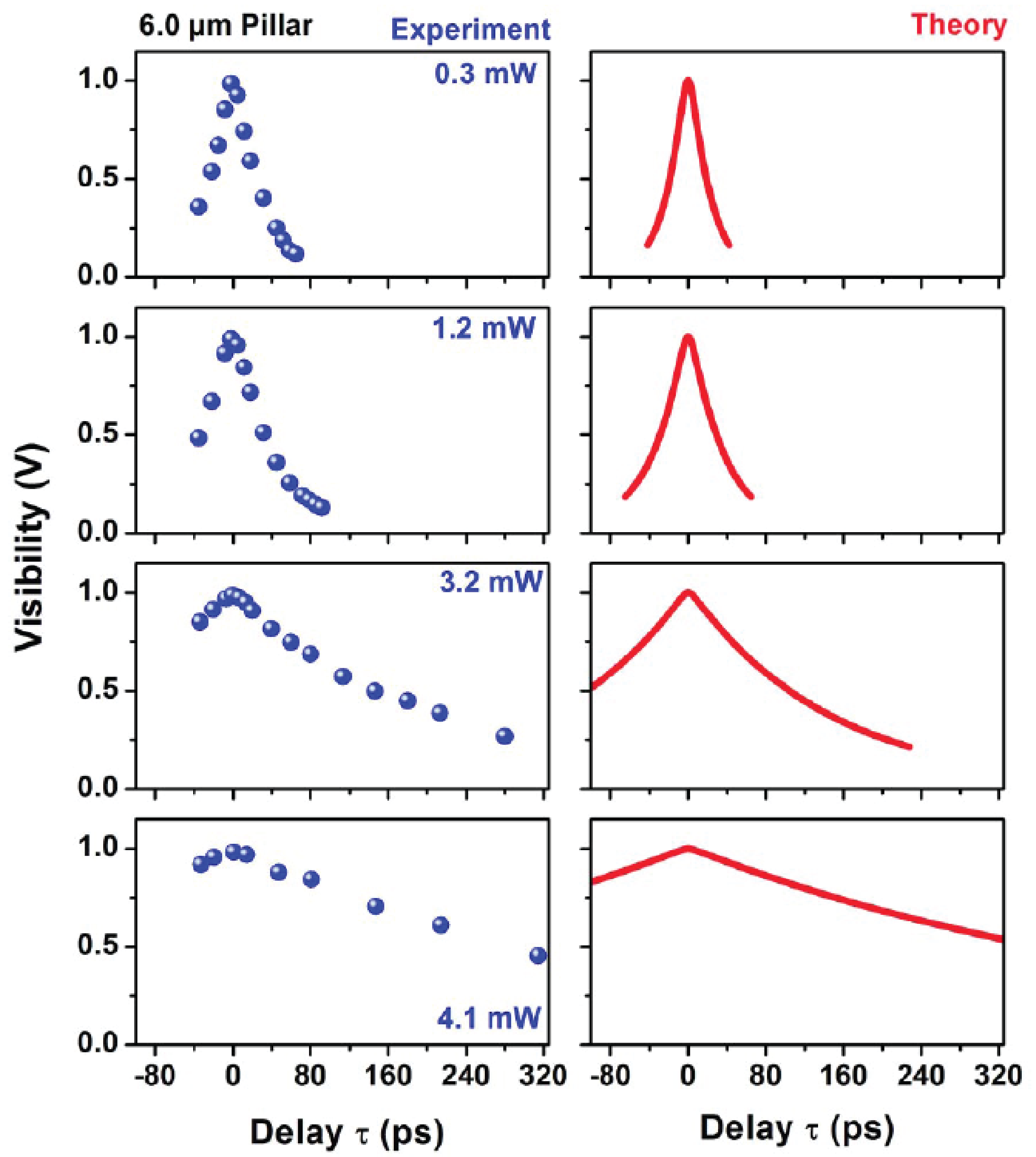 |
| 4. | S Ates; C Gies; S M Ulrich; J Wiersig; S Reitzenstein; A Löffler; A Forchel; F Jahnke; P Michler Influence of the spontaneous optical emission factor β on the first-order coherence of a semiconductor microcavity laser Journal Article Physical Review B, 78 , pp. 155319, 2008. @article{Ates2008b, title = {Influence of the spontaneous optical emission factor β on the first-order coherence of a semiconductor microcavity laser}, author = {S Ates and C Gies and S M Ulrich and J Wiersig and S Reitzenstein and A Löffler and A Forchel and F Jahnke and P Michler}, url = {http://journals.aps.org/prb/abstract/10.1103/PhysRevB.78.155319}, doi = {10.1103/PhysRevB.78.155319}, year = {2008}, date = {2008-10-22}, journal = {Physical Review B}, volume = {78}, pages = {155319}, abstract = {A systematic experimental and theoretical study of first-order coherence properties of high-β quantum-dot micropillar lasers is presented. A nonlinear increase in the coherence length is found in the transition regime from spontaneous to dominantly stimulated emission. This increase is accompanied by a qualitative change in the first-order field-correlation function g(1)(τ) from a Gaussian-type profile to an exponential behavior, which is in excellent agreement with a microscopic semiconductor laser theory. Our results also demonstrate a decreasing coherence length with increasing spontaneous emission coupling β, thus raising questions about the practicability of high-β lasers for device applications.}, keywords = {}, pubstate = {published}, tppubtype = {article} } A systematic experimental and theoretical study of first-order coherence properties of high-β quantum-dot micropillar lasers is presented. A nonlinear increase in the coherence length is found in the transition regime from spontaneous to dominantly stimulated emission. This increase is accompanied by a qualitative change in the first-order field-correlation function g(1)(τ) from a Gaussian-type profile to an exponential behavior, which is in excellent agreement with a microscopic semiconductor laser theory. Our results also demonstrate a decreasing coherence length with increasing spontaneous emission coupling β, thus raising questions about the practicability of high-β lasers for device applications. | 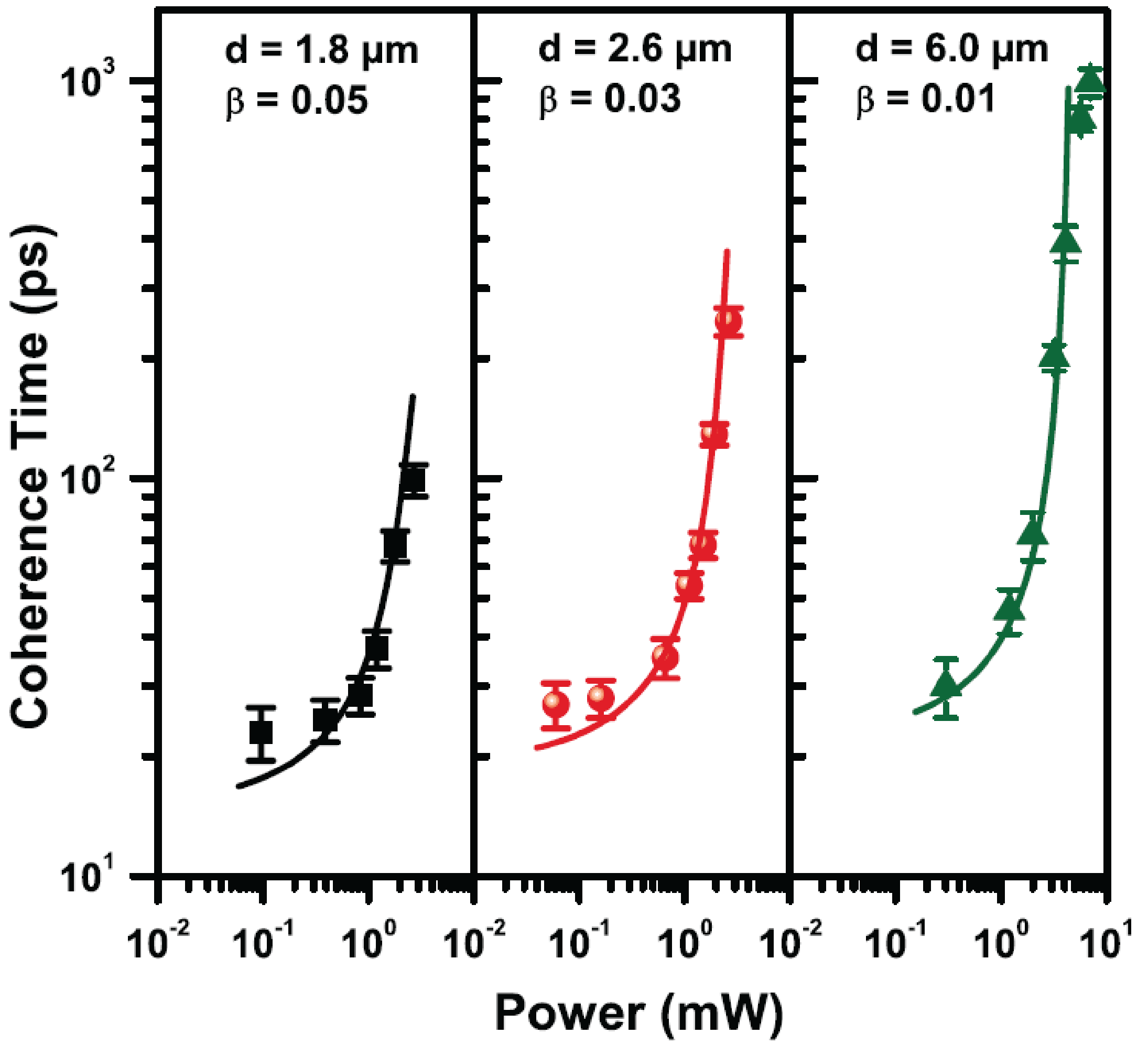 |
| 3. | S M Ulrich; S Ates; P Michler; C Gies; J Wiersig; F Jahnke; S Reitzenstein; C Hofmann; A Löffler; A Forchel Emission Characteristics, Photon Statistics and Coherence Properties of high-β Semiconductor Micropillar Lasers Book Chapter Advances in Solid State Physics 47, pp. 3-15, 2008, ISBN: 978-3-540-74325-5. @inbook{Ulrich2008, title = {Emission Characteristics, Photon Statistics and Coherence Properties of high-β Semiconductor Micropillar Lasers}, author = {S M Ulrich and S Ates and P Michler and C Gies and J Wiersig and F Jahnke and S Reitzenstein and C Hofmann and A Löffler and A Forchel}, url = {http://link.springer.com/chapter/10.1007/978-3-540-74325-5_1}, doi = {10.1007/978-3-540-74325-5_1}, isbn = {978-3-540-74325-5}, year = {2008}, date = {2008-10-07}, booktitle = {Advances in Solid State Physics 47}, pages = {3-15}, abstract = {We report on complementary experiment-theory investigations regarding the photon emission statistics and coherence properties of quantum dot-based semiconductor micropillar lasers with high β factors, i.e., a large coupling of spontaneous emission into the lasing mode. In terms of power-dependent first- and second-order photon correlation measurements, our results consistently reveal a smooth transition between the regimes of spontaneous and mainly stimulated emission. The gradual onset of lasing is accompanied by strong photon number fluctuations and distinct changes of the field coherence length. In particular, the regime of stabilized coherent emission is found to establish at significantly increased excitation levels above the lasing onsets. As was verified by detailed semiconductor-theoretical calculations on the characteristics of these type of resonator devices, the smooth transition from thermal to coherent emission should indeed become increasingly harder to determine with β → 1.}, keywords = {}, pubstate = {published}, tppubtype = {inbook} } We report on complementary experiment-theory investigations regarding the photon emission statistics and coherence properties of quantum dot-based semiconductor micropillar lasers with high β factors, i.e., a large coupling of spontaneous emission into the lasing mode. In terms of power-dependent first- and second-order photon correlation measurements, our results consistently reveal a smooth transition between the regimes of spontaneous and mainly stimulated emission. The gradual onset of lasing is accompanied by strong photon number fluctuations and distinct changes of the field coherence length. In particular, the regime of stabilized coherent emission is found to establish at significantly increased excitation levels above the lasing onsets. As was verified by detailed semiconductor-theoretical calculations on the characteristics of these type of resonator devices, the smooth transition from thermal to coherent emission should indeed become increasingly harder to determine with β → 1. | 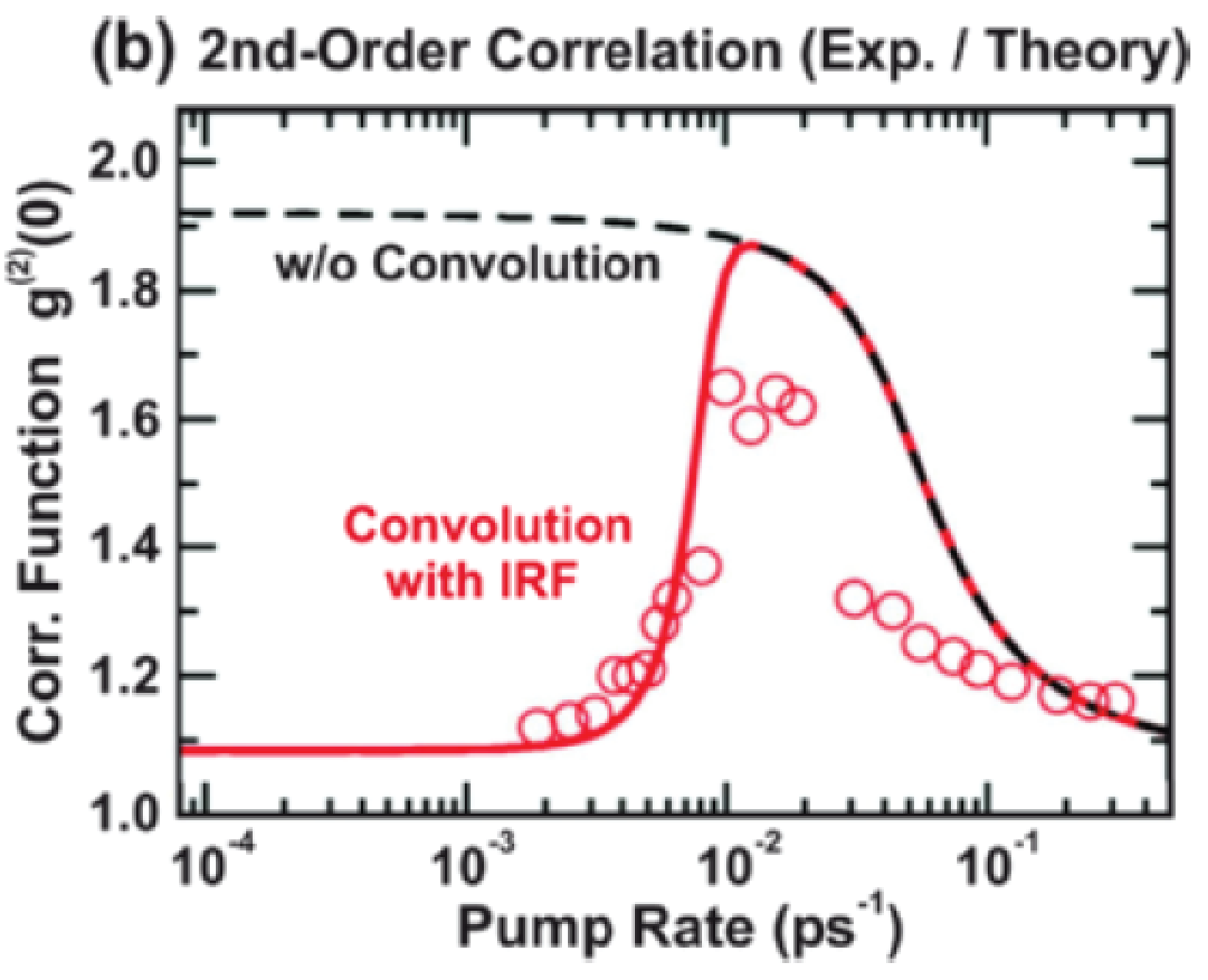 |
| 2. | S Ates; S M Ulrich; P Michler; S Reitzenstein; A Löffler; A Forchel Coherence properties of high-β elliptical semiconductor micropillar lasers Journal Article Applied Physics Letters, 90 , pp. 161111, 2007. @article{Ates2007, title = {Coherence properties of high-β elliptical semiconductor micropillar lasers}, author = {S Ates and S M Ulrich and P Michler and S Reitzenstein and A Löffler and A Forchel}, url = {http://scitation.aip.org/content/aip/journal/apl/90/16/10.1063/1.2724908}, doi = {10.1063/1.2724908}, year = {2007}, date = {2007-04-17}, journal = {Applied Physics Letters}, volume = {90}, pages = {161111}, abstract = {The authors report complementary investigations on the coherence properties of spontaneous and stimulated emission from (In,Ga)As∕GaAs quantum-dot-based high-quality semiconductor micropillar cavities. Low temperature micro-photoluminescence measurements on an elliptically shaped micropillar revealed a clear polarization splitting (ΔE∼45 μeV) of its fundamental mode. Full conformity is found with an oscillatory behavior observed in corresponding g(1)(τ) first-order field correlation measurements. In addition, power-dependent g(1)(τ) series on a single polarization component of the lasing mode have systematically revealed a strong coherence time increase from τc∼25 to∼430 ps, which traces the change of emission characteristics from thermal to coherent light.}, keywords = {}, pubstate = {published}, tppubtype = {article} } The authors report complementary investigations on the coherence properties of spontaneous and stimulated emission from (In,Ga)As∕GaAs quantum-dot-based high-quality semiconductor micropillar cavities. Low temperature micro-photoluminescence measurements on an elliptically shaped micropillar revealed a clear polarization splitting (ΔE∼45 μeV) of its fundamental mode. Full conformity is found with an oscillatory behavior observed in corresponding g(1)(τ) first-order field correlation measurements. In addition, power-dependent g(1)(τ) series on a single polarization component of the lasing mode have systematically revealed a strong coherence time increase from τc∼25 to∼430 ps, which traces the change of emission characteristics from thermal to coherent light. | 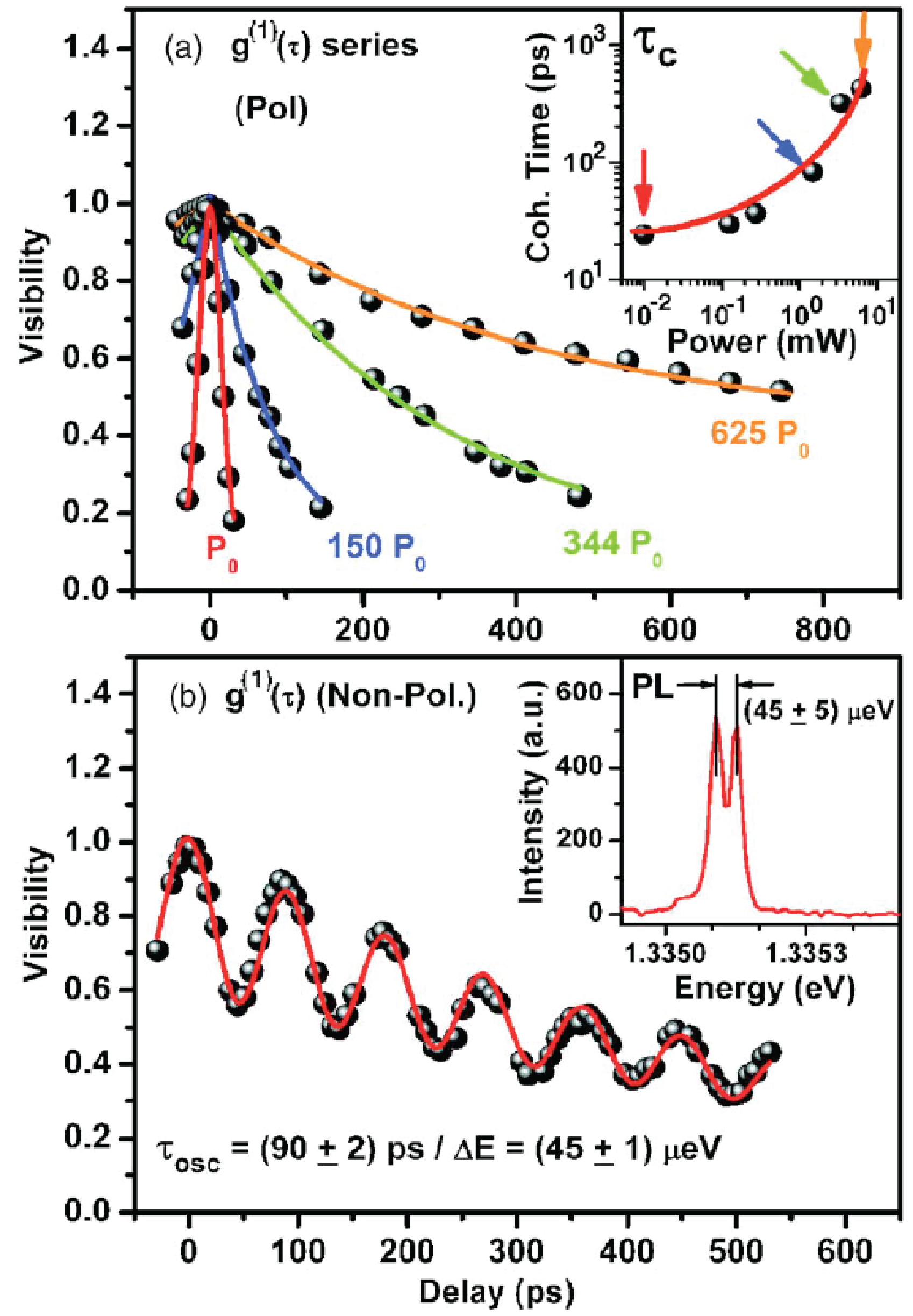 |
| 1. | S M Ulrich; C Gies; S Ates; J Wiersig; S Reitzenstein; C Hofmann; A Löffler; A Forchel; F Jahnke; P Michler Photon statistics of semiconductor microcavity lasers Journal Article Physical Review Letters, 98 , pp. 043906, 2007. @article{Ulrich2007, title = {Photon statistics of semiconductor microcavity lasers}, author = {S M Ulrich and C Gies and S Ates and J Wiersig and S Reitzenstein and C Hofmann and A Löffler and A Forchel and F Jahnke and P Michler}, url = {http://journals.aps.org/prl/abstract/10.1103/PhysRevLett.98.043906}, doi = {10.1103/PhysRevLett.98.043906}, year = {2007}, date = {2007-01-25}, journal = {Physical Review Letters}, volume = {98}, pages = {043906}, abstract = {We present measurements of first- and second-order coherence of quantum-dot micropillar lasers together with a semiconductor laser theory. Our results show a broad threshold region for the observed high-β microcavities. The intensity jump is accompanied by both pronounced photon intensity fluctuations and strong coherence length changes. The investigations clearly visualize a smooth transition from spontaneous to predominantly stimulated emission which becomes harder to determine for high β. In our theory, a microscopic approach is used to incorporate the semiconductor nature of quantum dots. The results are in agreement with the experimental intensity traces and the photon statistics measurements.}, keywords = {}, pubstate = {published}, tppubtype = {article} } We present measurements of first- and second-order coherence of quantum-dot micropillar lasers together with a semiconductor laser theory. Our results show a broad threshold region for the observed high-β microcavities. The intensity jump is accompanied by both pronounced photon intensity fluctuations and strong coherence length changes. The investigations clearly visualize a smooth transition from spontaneous to predominantly stimulated emission which becomes harder to determine for high β. In our theory, a microscopic approach is used to incorporate the semiconductor nature of quantum dots. The results are in agreement with the experimental intensity traces and the photon statistics measurements. | 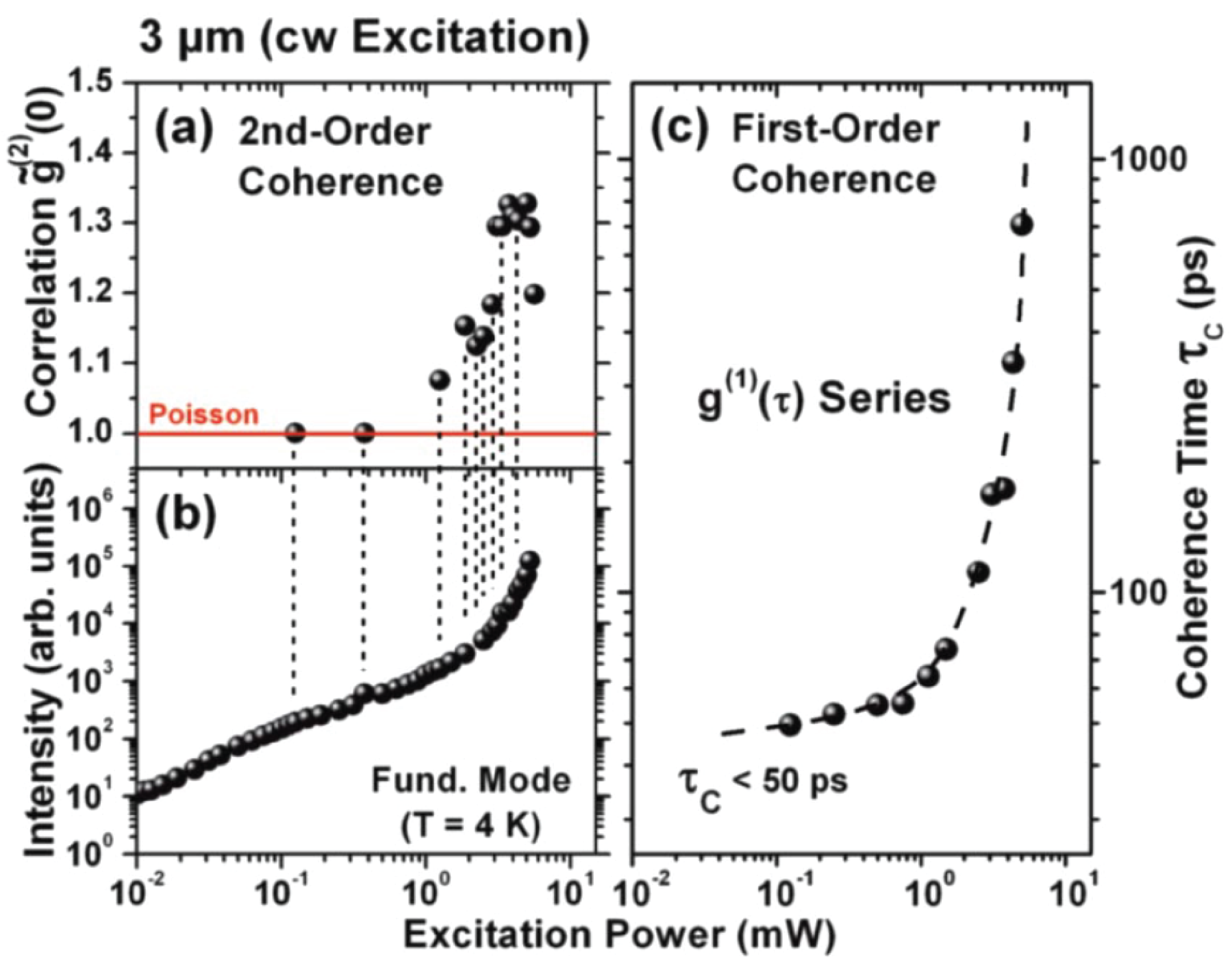 |