

Furkan Ağlarcı graduated from the physics department at Izmir Institude of Technology in 2021. In his senior year of the BSc, he joined the Nanophotonics and Quantum Optics group as an intern to study nanoplasmonics. He completed his MSc degree on entangled photon pairs generation for quantum information technologies and now continues his PhD studies on solid-state quantum optics and applications.
Research Topic: Quantum Key Distribution with Solid State Quantum Emitters
Sinan Genc; Oguzhan Yucel; Furkan Aglarci; Carlos Rodriguez-Fernandez; Alpay Yilmaz; Humeyra Caglayan; Serkan Ates; Alpan Bek Disorder-Engineered Hybrid Plasmonic Cavities for Emission Control of Defects in hBN Journal Article arXiv:2506.14517, 2025. @article{Genc.Bek.2025, title = {Disorder-Engineered Hybrid Plasmonic Cavities for Emission Control of Defects in hBN}, author = {Sinan Genc and Oguzhan Yucel and Furkan Aglarci and Carlos Rodriguez-Fernandez and Alpay Yilmaz and Humeyra Caglayan and Serkan Ates and Alpan Bek}, doi = {10.48550/arXiv.2506.14517}, year = {2025}, date = {2025-06-17}, journal = {arXiv:2506.14517}, abstract = {Defect-based quantum emitters in hexagonal boron nitride (hBN) are promising building blocks for scalable quantum photonics due to their stable single-photon emission at room temperature. However, enhancing their emission intensity and controlling the decay dynamics remain significant challenges. This study demonstrates a low-cost, scalable fabrication approach to integrate plasmonic nanocavities with defect-based quantum emitters in hBN nanoflakes. Using the thermal dewetting process, we realize two distinct configurations: stochastic Ag nanoparticles (AgNPs) on hBN flakes and hybrid plasmonic nanocavities formed by AgNPs on top of hBN flakes supported on gold/silicon dioxide (Au/SiO2) substrates. While AgNPs on bare hBN yield up to a two-fold photoluminescence (PL) enhancement with reduced emitter lifetimes, the hybrid nanocavity architecture provides a dramatic, up to 100-fold PL enhancement and improved uniformity across multiple. emitters, all without requiring deterministic positioning. Finite-difference time-domain (FDTD) simulations and time-resolved PL measurements confirm size-dependent control over decay dynamics and cavity-emitter interactions. Our versatile solution overcomes key quantum photonic device development challenges, including material integration, emission intensity optimization, and spectral multiplexity. Future work will explore potential applications in integrated photonic circuits hosting on-chip quantum systems and hBN-based label-free single-molecule detection through such quantum nanoantennas.}, keywords = {}, pubstate = {published}, tppubtype = {article} } Defect-based quantum emitters in hexagonal boron nitride (hBN) are promising building blocks for scalable quantum photonics due to their stable single-photon emission at room temperature. However, enhancing their emission intensity and controlling the decay dynamics remain significant challenges. This study demonstrates a low-cost, scalable fabrication approach to integrate plasmonic nanocavities with defect-based quantum emitters in hBN nanoflakes. Using the thermal dewetting process, we realize two distinct configurations: stochastic Ag nanoparticles (AgNPs) on hBN flakes and hybrid plasmonic nanocavities formed by AgNPs on top of hBN flakes supported on gold/silicon dioxide (Au/SiO2) substrates. While AgNPs on bare hBN yield up to a two-fold photoluminescence (PL) enhancement with reduced emitter lifetimes, the hybrid nanocavity architecture provides a dramatic, up to 100-fold PL enhancement and improved uniformity across multiple. emitters, all without requiring deterministic positioning. Finite-difference time-domain (FDTD) simulations and time-resolved PL measurements confirm size-dependent control over decay dynamics and cavity-emitter interactions. Our versatile solution overcomes key quantum photonic device development challenges, including material integration, emission intensity optimization, and spectral multiplexity. Future work will explore potential applications in integrated photonic circuits hosting on-chip quantum systems and hBN-based label-free single-molecule detection through such quantum nanoantennas. | 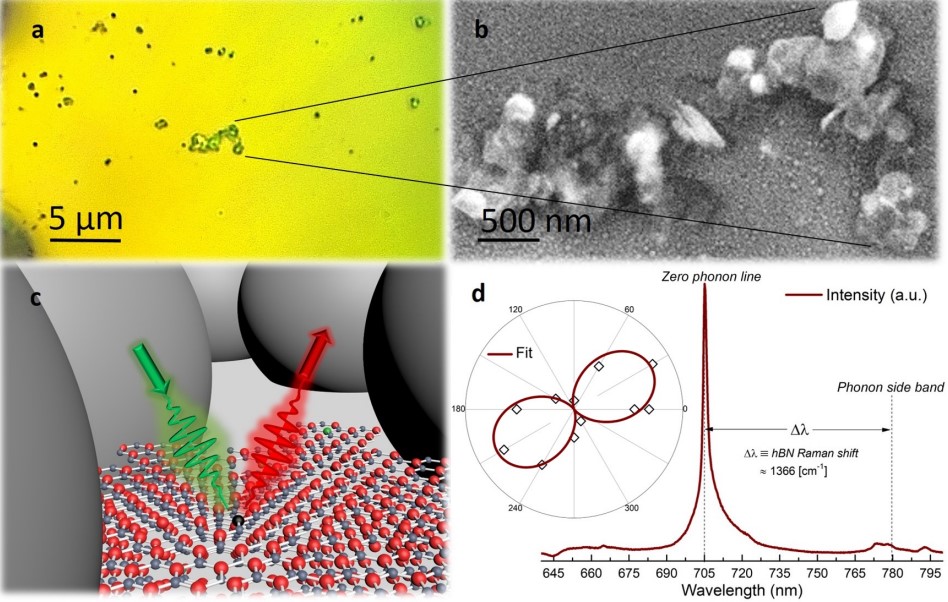 |
Ömer S. Tapşın, Furkan Ağlarcı, Roberto G. Pousa, Daniel K. L. Oi, Mustafa Gündoğan, Serkan Ateş Secure Quantum Key Distribution with Room-Temperature Quantum Emitter Journal Article arXiv:2501.13902, 2025. @article{Tapsin2025, title = {Secure Quantum Key Distribution with Room-Temperature Quantum Emitter}, author = {Ömer S. Tapşın, Furkan Ağlarcı, Roberto G. Pousa, Daniel K. L. Oi, Mustafa Gündoğan, Serkan Ateş}, url = {https://arxiv.org/abs/2501.13902}, doi = {10.48550/arXiv.2501.13902}, year = {2025}, date = {2025-04-24}, journal = {arXiv:2501.13902}, abstract = {On-demand generation of single photons from solid-state quantum emitters is essential to build practical quantum networks and QKD systems by potentially enabling higher secure key rates (SKR) and lower quantum bit error rates (QBER) in short-range distances. Room-temperature operation is particularly important as it eliminates the need for bulky cryogenic setups, reducing complexity and cost for real-world applications. In this work, we showcase the versatility of defects in hexagonal boron nitride (hBN) at room temperature by implementing the B92 protocol. Our experiments yield a sifted key rate (SiKR) of 17.5 kbps with a QBER of 6.49% at a dynamic polarization encoding rate of 40 MHz, and finite-key analysis provides a SKR of 7 kbps, one of the highest achieved for a room-temperature single photon source. We analyzed the non-decoy efficient BB84 using our hBN emitter and other promising quantum dot source for QKD, and compare their key performance with a single quantum repeater scenario. We also explore potential applications of hBN defects beyond QKD and analyze scenarios that could outperform conventional point-to-point QKD schemes. These results underscore the promise of hBN emitters for advancing quantum communication technologies.}, keywords = {}, pubstate = {published}, tppubtype = {article} } On-demand generation of single photons from solid-state quantum emitters is essential to build practical quantum networks and QKD systems by potentially enabling higher secure key rates (SKR) and lower quantum bit error rates (QBER) in short-range distances. Room-temperature operation is particularly important as it eliminates the need for bulky cryogenic setups, reducing complexity and cost for real-world applications. In this work, we showcase the versatility of defects in hexagonal boron nitride (hBN) at room temperature by implementing the B92 protocol. Our experiments yield a sifted key rate (SiKR) of 17.5 kbps with a QBER of 6.49% at a dynamic polarization encoding rate of 40 MHz, and finite-key analysis provides a SKR of 7 kbps, one of the highest achieved for a room-temperature single photon source. We analyzed the non-decoy efficient BB84 using our hBN emitter and other promising quantum dot source for QKD, and compare their key performance with a single quantum repeater scenario. We also explore potential applications of hBN defects beyond QKD and analyze scenarios that could outperform conventional point-to-point QKD schemes. These results underscore the promise of hBN emitters for advancing quantum communication technologies. | 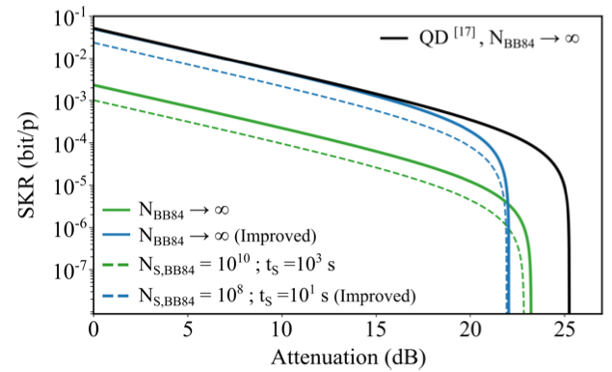 |