
Serkan Paçal received his Bachelor of Science degree in 2016 from Ege University Physics Department in Turkey. He attended the MSc program at İzmir Institute of Technology in 2017 and completed his research on quantum tunneling time. In 2021, he joined the Nanophononics and Quantum Optics Laboratory for his PhD studies and continues his research on Quantum Key Distribution with Solid-State Quantum Emitters.
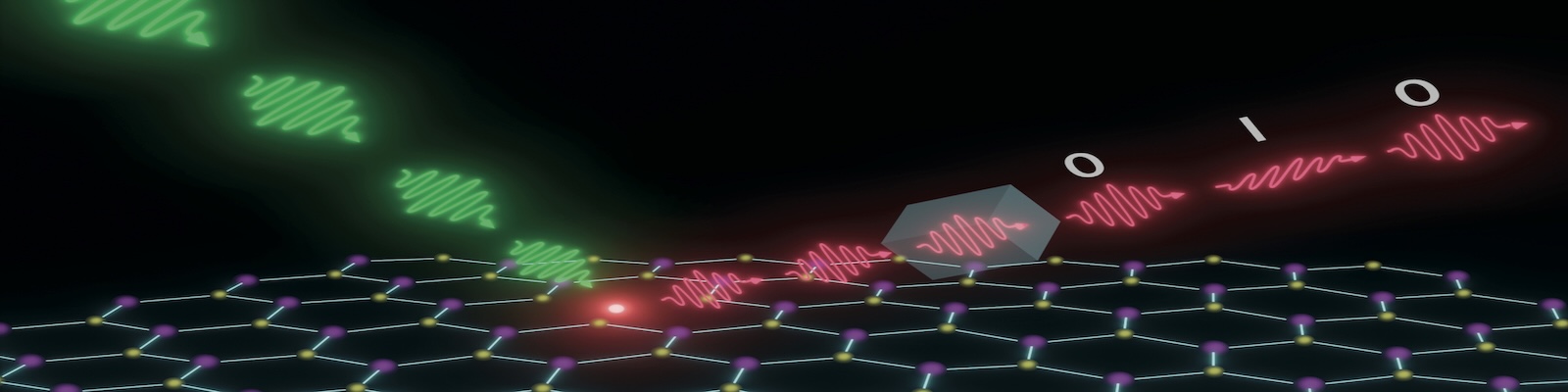
Research Topic: Quantum Key Distribution with Solid State Quantum Emitters
J.-V. Vidal Martínez-Pons, S.-K. Kim, M. Behrens, A. Izquierdo-Molina, A. Menendez Rua, S. Paçal, S. Ateş, L. Viña, C. Antón-Solanas Temporal coherence of single photons emitted by hexagonal Boron Nitride defects at room temperature Journal Article arXiv:2505.10644, 2025. @article{Vidal_2025, title = {Temporal coherence of single photons emitted by hexagonal Boron Nitride defects at room temperature}, author = {J.-V. Vidal Martínez-Pons, S.-K. Kim, M. Behrens, A. Izquierdo-Molina, A. Menendez Rua, S. Paçal, S. Ateş, L. Viña, C. Antón-Solanas}, url = {https://arxiv.org/abs/2505.10644}, doi = {https://doi.org/10.48550/arXiv.2505.10644}, year = {2025}, date = {2025-05-15}, journal = {arXiv:2505.10644}, abstract = {Color centers in hexagonal boron nitride (hBN) emerge as promising quantum light sources at room temperature, with potential applications in quantum communications, among others. The temporal coherence of emitted photons (i.e. their capacity to interfere and distribute photonic entanglement) is essential for many of these applications. Hence, it is crucial to study and determine the temporal coherence of this emission under different experimental conditions. In this work, we report the coherence time of the single photons emitted by an hBN defect in a nanocrystal at room temperature, measured via Michelson interferometry. The visibility of this interference vanishes when the temporal delay between the interferometer arms is a few hundred femtoseconds, highlighting that the phonon dephasing processes are four orders of magnitude faster than the spontaneous decay time of the emitter. We also analyze the single photon characteristics of the emission via correlation measurements, defect blinking dynamics, and its Debye-Waller factor. Our room temperature results highlight the presence of a strong phonon-electron coupling, suggesting the need to work at cryogenic temperatures to enable quantum photonic applications based on photon interference.}, keywords = {}, pubstate = {published}, tppubtype = {article} } Color centers in hexagonal boron nitride (hBN) emerge as promising quantum light sources at room temperature, with potential applications in quantum communications, among others. The temporal coherence of emitted photons (i.e. their capacity to interfere and distribute photonic entanglement) is essential for many of these applications. Hence, it is crucial to study and determine the temporal coherence of this emission under different experimental conditions. In this work, we report the coherence time of the single photons emitted by an hBN defect in a nanocrystal at room temperature, measured via Michelson interferometry. The visibility of this interference vanishes when the temporal delay between the interferometer arms is a few hundred femtoseconds, highlighting that the phonon dephasing processes are four orders of magnitude faster than the spontaneous decay time of the emitter. We also analyze the single photon characteristics of the emission via correlation measurements, defect blinking dynamics, and its Debye-Waller factor. Our room temperature results highlight the presence of a strong phonon-electron coupling, suggesting the need to work at cryogenic temperatures to enable quantum photonic applications based on photon interference. | 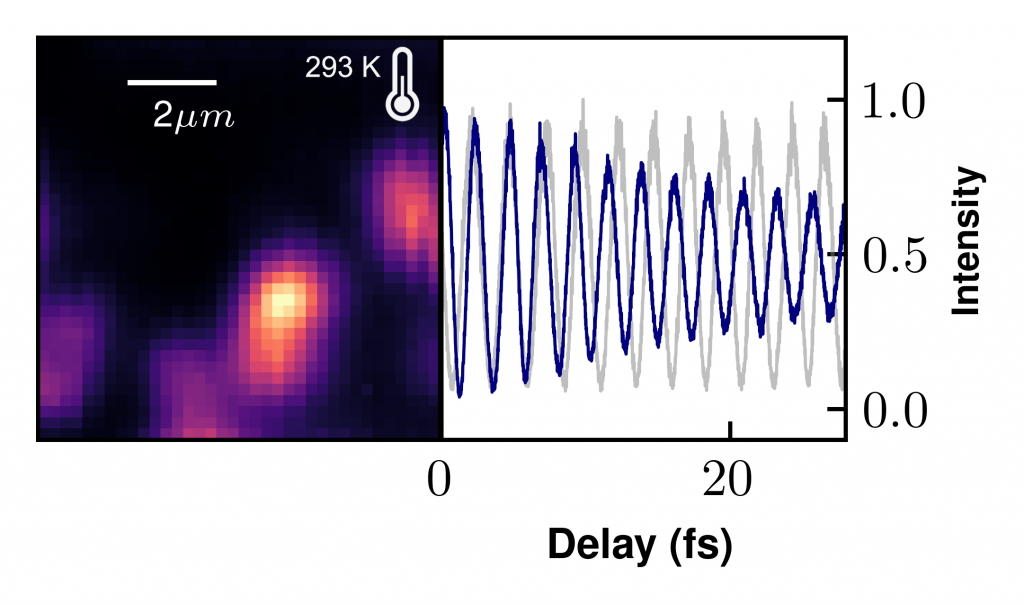 |
Aslı Çakan; Chanaprom Cholsuk; Angus Gale; Mehran Kianinia; Serkan Paçal; Serkan Ateş; Igor Aharonovich; Milos Toth; Tobias Vogl Quantum Optics Applications of Hexagonal Boron Nitride Defects Journal Article Advanced Optical Materials, pp. 2402508, 2025. @article{Çakan2024, title = {Quantum Optics Applications of Hexagonal Boron Nitride Defects}, author = {Aslı Çakan and Chanaprom Cholsuk and Angus Gale and Mehran Kianinia and Serkan Paçal and Serkan Ateş and Igor Aharonovich and Milos Toth and Tobias Vogl}, url = {https://advanced.onlinelibrary.wiley.com/doi/10.1002/adom.202402508}, doi = {10.1002/adom.202402508}, year = {2025}, date = {2025-02-13}, journal = {Advanced Optical Materials}, pages = {2402508}, abstract = {Hexagonal boron nitride (hBN) has emerged as a compelling platform for both classical and quantum technologies. In particular, the past decade has witnessed a surge of novel ideas and developments, which may be overwhelming for newcomers to the field. This review provides an overview of the fundamental concepts and key applications of hBN, including quantum sensing, quantum key distribution, quantum computing, and quantum memory. Additionally, critical experimental and theoretical advances that have expanded the capabilities of hBN are highlighted, in a cohesive and accessible manner. The objective is to equip readers with a comprehensive understanding of the diverse applications of hBN, and provide insights into ongoing research efforts.}, keywords = {}, pubstate = {published}, tppubtype = {article} } Hexagonal boron nitride (hBN) has emerged as a compelling platform for both classical and quantum technologies. In particular, the past decade has witnessed a surge of novel ideas and developments, which may be overwhelming for newcomers to the field. This review provides an overview of the fundamental concepts and key applications of hBN, including quantum sensing, quantum key distribution, quantum computing, and quantum memory. Additionally, critical experimental and theoretical advances that have expanded the capabilities of hBN are highlighted, in a cohesive and accessible manner. The objective is to equip readers with a comprehensive understanding of the diverse applications of hBN, and provide insights into ongoing research efforts. | 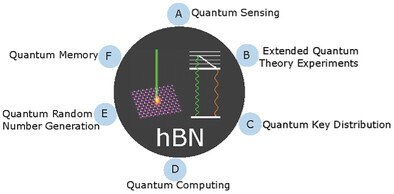 |
Anand Kumar; Çağlar Samaner; Chanaprom Cholsuk; Tjorben Matthes; Serkan Paçal; Yağız Oyun; Ashkan Zand; Robert J. Chapman; Grégoire Saerens; Rachel Grange; Sujin Suwanna; Serkan Ateş; Tobias Vogl Polarization Dynamics of Solid-State Quantum Emitters Journal Article ACS Nano, 2024. @article{Caglar2024, title = {Polarization Dynamics of Solid-State Quantum Emitters}, author = {Anand Kumar and Çağlar Samaner and Chanaprom Cholsuk and Tjorben Matthes and Serkan Paçal and Yağız Oyun and Ashkan Zand and Robert J. Chapman and Grégoire Saerens and Rachel Grange and Sujin Suwanna and Serkan Ateş and Tobias Vogl}, url = {https://doi.org/10.1021/acsnano.3c08940}, doi = {10.1021/acsnano.3c08940}, year = {2024}, date = {2024-02-09}, journal = {ACS Nano}, abstract = {Quantum emitters in solid-state crystals have recently attracted a great deal of attention due to their simple applicability in optical quantum technologies. The polarization of single photons generated by quantum emitters is one of the key parameters that plays a crucial role in various applications, such as quantum computation, which uses the indistinguishability of photons. However, the degree of single-photon polarization is typically quantified using the time-averaged photoluminescence intensity of single emitters, which provides limited information about the dipole properties in solids. In this work, we use single defects in hexagonal boron nitride and nanodiamond as efficient room-temperature single-photon sources to reveal the origin and temporal evolution of the dipole orientation in solid-state quantum emitters. The angles of the excitation and emission dipoles relative to the crystal axes were determined experimentally and then calculated using density functional theory, which resulted in characteristic angles for every specific defect that can be used as an efficient tool for defect identification and understanding their atomic structure. Moreover, the temporal polarization dynamics revealed a strongly modified linear polarization visibility that depends on the excited-state decay time of the individual excitation. This effect can potentially be traced back to the excitation of excess charges in the local crystal environment. Understanding such hidden time-dependent mechanisms can further improve the performance of polarization-sensitive experiments, particularly that for quantum communication with single-photon emitters.}, keywords = {}, pubstate = {published}, tppubtype = {article} } Quantum emitters in solid-state crystals have recently attracted a great deal of attention due to their simple applicability in optical quantum technologies. The polarization of single photons generated by quantum emitters is one of the key parameters that plays a crucial role in various applications, such as quantum computation, which uses the indistinguishability of photons. However, the degree of single-photon polarization is typically quantified using the time-averaged photoluminescence intensity of single emitters, which provides limited information about the dipole properties in solids. In this work, we use single defects in hexagonal boron nitride and nanodiamond as efficient room-temperature single-photon sources to reveal the origin and temporal evolution of the dipole orientation in solid-state quantum emitters. The angles of the excitation and emission dipoles relative to the crystal axes were determined experimentally and then calculated using density functional theory, which resulted in characteristic angles for every specific defect that can be used as an efficient tool for defect identification and understanding their atomic structure. Moreover, the temporal polarization dynamics revealed a strongly modified linear polarization visibility that depends on the excited-state decay time of the individual excitation. This effect can potentially be traced back to the excitation of excess charges in the local crystal environment. Understanding such hidden time-dependent mechanisms can further improve the performance of polarization-sensitive experiments, particularly that for quantum communication with single-photon emitters. | 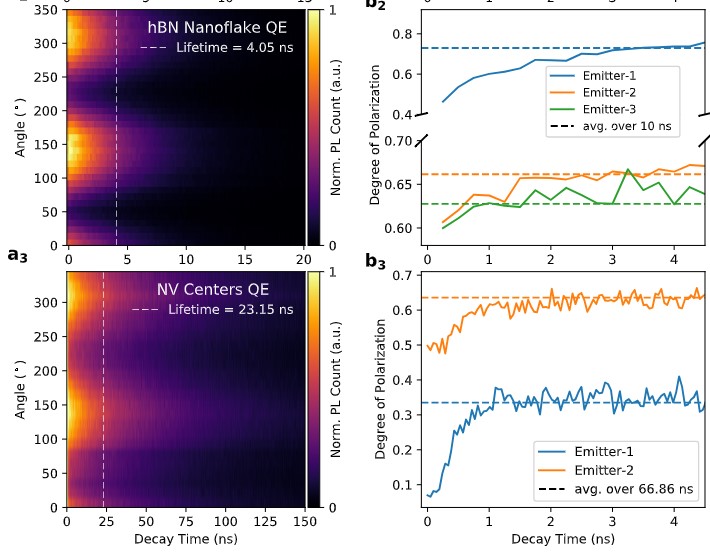 |
Çağlar Samaner; Serkan Paçal; Görkem Mutlu; Kıvanç Uyanık; Serkan Ates Free-Space Quantum Key Distribution with Single Photons from Defects in Hexagonal Boron Nitride Journal Article Advanced Quantum Technologies, 5 , 2022. @article{Caglar2022, title = {Free-Space Quantum Key Distribution with Single Photons from Defects in Hexagonal Boron Nitride}, author = {Çağlar Samaner and Serkan Paçal and Görkem Mutlu and Kıvanç Uyanık and Serkan Ates}, url = {https://onlinelibrary.wiley.com/doi/10.1002/qute.202200059}, doi = {10.1002/qute.202200059}, year = {2022}, date = {2022-08-03}, journal = {Advanced Quantum Technologies}, volume = {5}, abstract = {We present a proof-of-concept demonstration of free-space quantum key distribution (QKD) with single photons generated from an isolated defect in hexagonal boron nitride (hBN). The source, operating at room temperature with a 10% brightness, is integrated into a B92 protocol and a secure key rate (SKR) of 238 bps and a quantum bit error rate (QBER) of 8.95% are achieved with 1 MHz clock rate. The effect of temporal filtering of detected photons on the performance of QKD parameters is also studied. We believe that our results will accelerate the work on improving the performance of optically active defects in hBN and their use in high-performance practical QKD systems.}, keywords = {}, pubstate = {published}, tppubtype = {article} } We present a proof-of-concept demonstration of free-space quantum key distribution (QKD) with single photons generated from an isolated defect in hexagonal boron nitride (hBN). The source, operating at room temperature with a 10% brightness, is integrated into a B92 protocol and a secure key rate (SKR) of 238 bps and a quantum bit error rate (QBER) of 8.95% are achieved with 1 MHz clock rate. The effect of temporal filtering of detected photons on the performance of QKD parameters is also studied. We believe that our results will accelerate the work on improving the performance of optically active defects in hBN and their use in high-performance practical QKD systems. |  |